Vertical Lifts
Aerial Work Platforms
Max Working Height:5.8–10.3 m
Platform Capacity:160–227 kg
Consult now






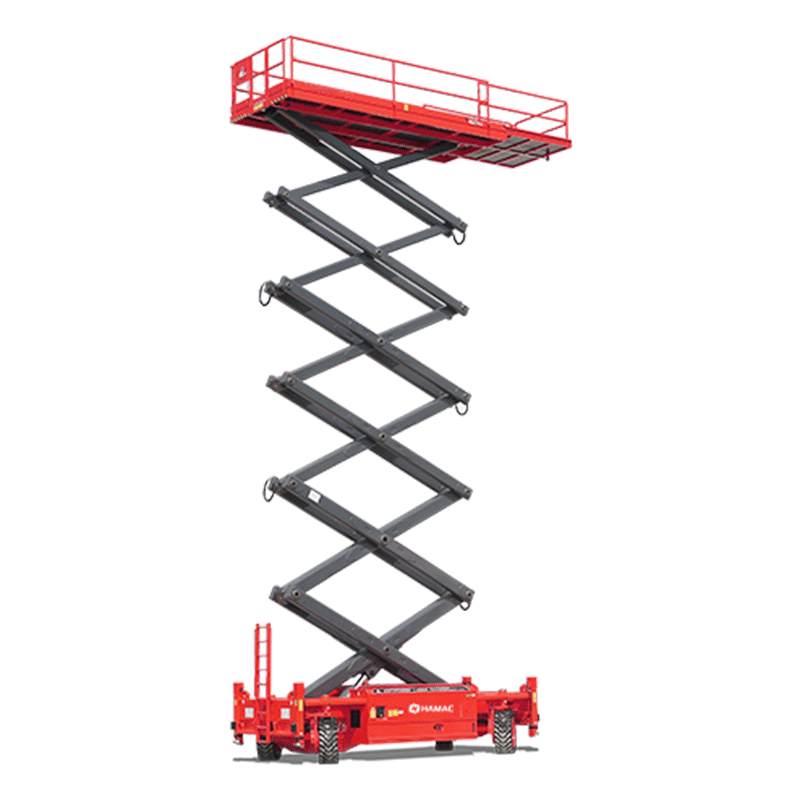
Before choosing a scissor lift, you need to know the required working height. This is the height an operator must safely reach to complete the actual task, such as replacing warehouse lighting, installing cable trays, servicing HVAC equipment, painting a ceiling, repairing a façade, or completing construction work.
Selecting the wrong working height can reduce productivity and create safety problems. A scissor lift that is too low may cause operators to overreach or use unsafe methods such as standing on ladders, boxes, or guardrails. A machine that is unnecessarily high may be larger, heavier, more expensive, and more difficult to transport or move through restricted access areas.
The best solution is to measure the real work point, calculate the required working height, add a practical working margin, and then select a scissor lift that also meets your platform-capacity, terrain, access, and power-source requirements.
Working height is the approximate maximum height that an operator can reach while standing on the elevated platform. It is commonly used by equipment manufacturers, rental companies, contractors, warehouse managers, and maintenance teams to select the correct scissor lift size.
Working height is different from platform height. Platform height is the vertical distance from the ground to the platform floor when the scissor lift is fully raised. Working height includes the operator’s approximate reach above the platform.
| Measurement | Meaning | Why It Matters |
|---|---|---|
| Ground level | The floor or ground where the scissor lift is positioned. | This is the starting point for all height measurements. |
| Platform height | The maximum elevation of the platform floor above the ground. | Shows the operator’s standing level. |
| Working height | The approximate maximum height that an operator can reach from the elevated platform. | Helps match the lift to a ceiling, light, pipe, cable tray, or other work point. |
| Task height | The actual height of the work point above the ground. | Determines the minimum working height required. |
| Task Type | Working Height Selection Approach |
|---|---|
| Simple visual inspection | A small working margin may be sufficient if access is clear and direct. |
| Lighting replacement | Allow enough height for workers to remove and install fixtures without stretching. |
| Electrical work | Allow room for tools, cables, cable trays, and safe operator movement. |
| HVAC or duct installation | Allow extra room for material handling, overhead structures, and installation angles. |
| Maintenance around beams or pipes | Allow additional clearance or choose a boom lift if direct access is limited. |
| Outdoor façade installation | Consider working position, wind limits, ground conditions, and possible obstacles. |
A warehouse has lighting fixtures installed at 8 m above the floor. The building has smooth concrete flooring, wide aisles, and no major overhead obstructions. Two technicians need to carry hand tools and replacement LED fixtures.
The required working height is 8 m. Using the general calculation:
8 m Working Height − 2 m Operator Reach = 6 m Platform Height
A compact electric scissor lift with approximately 6 m platform height and 8 m working height may be suitable. The buyer should also confirm whether the platform capacity is sufficient for two technicians, tools, fixtures, and any required materials.
A factory needs to install cable trays at 11 m above the floor. The work area has steel beams and existing pipework near the ceiling. The installation crew consists of two workers with cable trays, brackets, fasteners, power tools, and safety equipment.
The minimum estimated platform height is:
11 m Working Height − 2 m Operator Reach = 9 m Platform Height
Because the crew needs to work around overhead beams, pipework, tools, and materials, selecting only the minimum 9 m platform height may not provide enough room. A machine with approximately 10 m platform height and 12 m working height may be more practical.
The final selection should also consider platform capacity, platform extension, aisle width, machine dimensions, battery operating time, and whether the scissor lift can be positioned directly below the cable tray route.
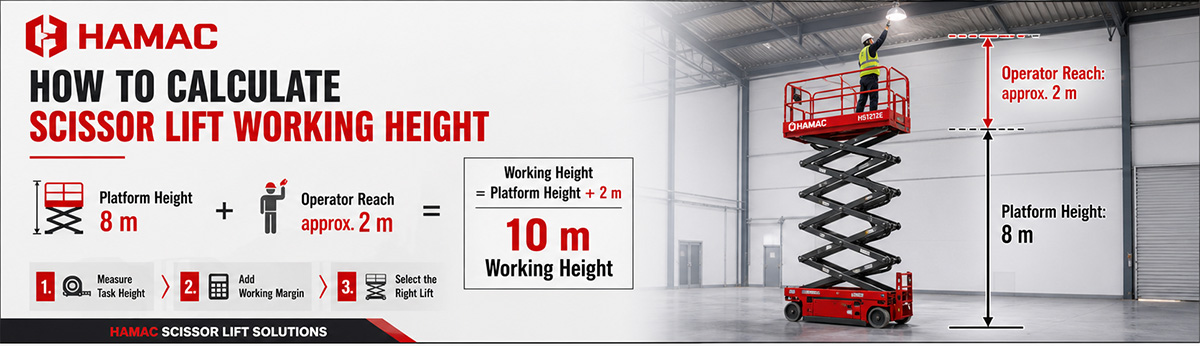
Platform height tells you how high the platform floor will rise. Working height tells you how high an operator can approximately reach while standing on the raised platform. Both figures are important, but the working height is usually the most useful number when selecting equipment for overhead work.
For many scissor lift models, working height is calculated by adding approximately 2 m to the maximum platform height. The additional 2 m represents the approximate standing reach of an operator.
Working Height = Platform Height + Approximately 2 m
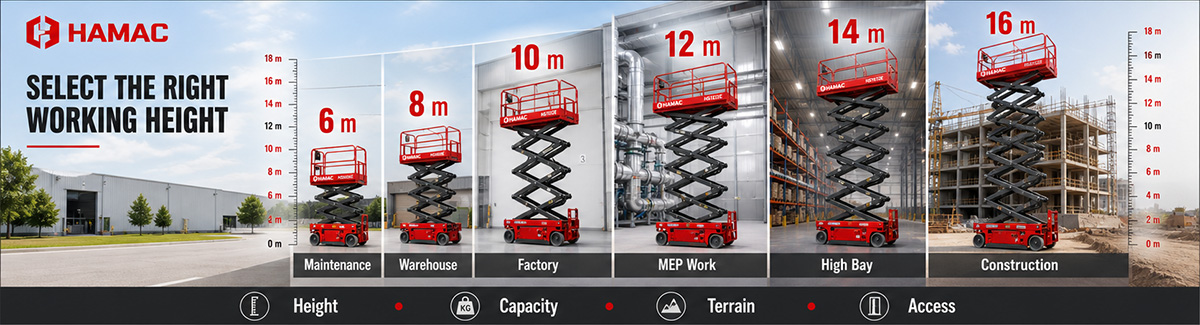
| Platform Height | Approximate Working Height | Typical Application |
|---|---|---|
| 4 m | 6 m | Low-level maintenance, shelving, cleaning, and lighting work |
| 5.8 m | 7.8 m | Retail facilities, workshops, low warehouses, and basic maintenance |
| 6 m | 8 m | Warehouses, factories, inventory work, and indoor maintenance |
| 8 m | 10 m | Racking service, factory lighting, cable trays, and installation work |
| 10 m | 12 m | Commercial facilities, MEP installation, HVAC work, and high warehouse projects |
| 12 m | 14 m | High-bay warehouses, industrial maintenance, and construction work |
| 14 m | 16 m | High-ceiling projects, outdoor installation, façade work, and steel structures |
| 16 m | 18 m | Demanding outdoor construction and high-access projects |
To calculate the working height you need, begin by measuring the highest actual point where workers must perform their task. Measure from the exact floor or ground level where the scissor lift will stand.
For example, if workers need to reach a lighting fixture at 10 m above the warehouse floor, the required working height is at least 10 m. A scissor lift with an 8 m platform height normally provides approximately 10 m working height.
You can use the following formula:
Required Platform Height = Required Working Height − Approximately 2 m
For a work point at 10 m:
10 m Required Working Height − 2 m Operator Reach = 8 m Required Platform Height
This means an 8 m platform-height scissor lift may be suitable. However, the final selection should also include a practical margin for safe posture, tool use, overhead obstacles, and the exact nature of the work.
Measure the exact point where the job will be performed. Do not estimate based on the total building height, roof height, or wall height. The target point may be a light fixture, sprinkler line, cable tray, air duct, beam, ceiling panel, racking level, sign, pipe, or façade connection.
Use a laser distance meter, tape measure, construction drawing, building plan, or verified site measurement. If the project includes several work areas at different heights, measure each one and use the highest required work point as the starting point for machine selection.
| Application | Correct Measurement Point |
|---|---|
| Warehouse lighting maintenance | Measure from the warehouse floor to the light fixture or electrical connection point. |
| HVAC maintenance | Measure from the operating floor to the duct, ventilation unit, filter point, or service area. |
| Cable tray installation | Measure to the final cable tray position, including the required working area around the tray. |
| Fire sprinkler maintenance | Measure to the sprinkler pipe, valve, support bracket, or inspection point. |
| Warehouse racking work | Measure to the required racking beam, upper shelf, inspection point, or overhead structure. |
| Exterior façade work | Measure from the actual ground position of the lift to the highest installation or repair point. |
| Steel structure installation | Measure to the beam, connection point, bolt position, panel, or installation area. |
A scissor lift provides mainly vertical movement. It is ideal when the work point is directly above or close to the machine. Some models have an extension deck that provides limited additional horizontal workspace, but this is not the same as a boom lift’s outreach.
Before selecting a scissor lift, check whether the machine can be positioned directly below the work area. If a wall, landscaping, pipe rack, roof edge, machinery, trench, storage rack, or other obstruction prevents direct positioning, another type of access equipment may be required.
| Work Condition | Recommended Equipment |
|---|---|
| The work point is directly above the machine | Scissor lift |
| The work point is slightly beyond the platform edge | Scissor lift with extension deck, if capacity and operating limits allow |
| The work point is behind a low obstacle | Articulating boom lift |
| The work point is far from the machine base | Telescopic boom lift |
| The work point is above landscaping, roof edges, or barriers | Articulating or telescopic boom lift |
| The work area is in a narrow indoor aisle | Compact electric scissor lift |
A scissor lift should not be selected only by the exact minimum calculated reach. Operators need room to work safely and comfortably, especially when using power tools, installing materials, handling cables, tightening bolts, or working around beams and pipework.
As a practical planning guideline, consider selecting a working-height class that provides approximately 0.5 m to 1 m of additional room above the highest measured task point. The correct margin depends on the operator’s position, tool length, overhead obstacles, required work angle, materials, and site conditions.
A construction contractor needs to install façade components at a maximum height of 14 m. The machine will operate outdoors on compacted gravel. Two workers need to carry tools and installation materials.
The estimated minimum platform height is:
14 m Working Height − 2 m Operator Reach = 12 m Platform Height
The contractor should consider a rough terrain scissor lift with at least 12 m platform height, suitable platform capacity, rugged tires, adequate ground clearance, and terrain capability appropriate for the approved jobsite surface.
If the lift cannot stand directly below the façade because of landscaping, drainage channels, barriers, uneven ground, or building offsets, an articulating boom lift or telescopic boom lift may be more suitable.
Always measure from the exact position where the machine will operate. A building or jobsite may have ramps, loading docks, pits, sloped floors, raised platforms, uneven yard areas, or different levels between one work area and another.
A height measurement taken from the wrong ground level can result in selecting a machine that is too low. For example, a task may be 10 m above the main floor, but the lift may need to operate from a lower loading area. In this case, the true required working height will be greater than 10 m.
| Site Condition | What to Check |
|---|---|
| Flat warehouse floor | Measure directly from the operating floor to the work point. |
| Raised loading dock | Measure from the dock surface if the lift will operate on the dock. |
| Ramp or sloped floor | Confirm whether the lift can operate safely and measure from the real working position. |
| Outdoor gravel or soil area | Check surface stability, local ground level changes, and terrain suitability. |
| Mezzanine or elevated floor | Check lift access, floor loading capacity, ceiling clearance, and work height from that level. |
| Uneven construction site | Assess the actual machine location, safe operating surface, and terrain capability before calculating final height. |
A scissor lift must have enough capacity to carry everyone and everything needed for the task. Capacity includes operators, personal protective equipment, tools, toolboxes, cables, materials, fixtures, brackets, fasteners, and approved accessories.
Once you have selected the required working height, calculate the complete platform load. A machine may reach the necessary height but still be unsuitable if its platform capacity is too low for the planned work.
| Example Load | Estimated Weight |
|---|---|
| Two operators with PPE | 180 kg |
| Tools and toolboxes | 40 kg |
| Installation materials | 90 kg |
| Cables and approved accessories | 25 kg |
| Total platform load | 335 kg |
For this example, a scissor lift with 230 kg rated platform capacity would not be suitable. The buyer should choose a machine with adequate rated capacity and also check the permitted load on any extension deck.
After calculating the required working height, select the machine type according to the jobsite environment. A correct height alone does not mean that every scissor lift is suitable.
| Jobsite Environment | Recommended Scissor Lift Type |
|---|---|
| Warehouse with level concrete flooring | Electric slab scissor lift |
| Factory, shopping mall, airport, or commercial building | Electric scissor lift with non-marking tires |
| Narrow warehouse aisles or door access | Compact narrow electric scissor lift |
| High indoor working point with materials | High-capacity electric scissor lift with suitable platform dimensions |
| Outdoor construction site with gravel or compacted soil | Rough terrain scissor lift |
| Outdoor work on uneven, soft, or demanding terrain | Rough terrain scissor lift or another appropriate access solution after site assessment |
| Work requiring horizontal outreach | Articulating boom lift or telescopic boom lift |
| Common Mistake | Potential Problem | Better Approach |
|---|---|---|
| Using total building height | The selected machine may not match the actual task location. | Measure the exact work point. |
| Confusing platform height with working height | Operators may not be able to safely reach the work area. | Check both platform height and working height. |
| Selecting the minimum height with no margin | Workers may need to stretch or work in an unsafe position. | Add a practical margin for safe and productive work. |
| Ignoring overhead obstacles | Beams, pipes, sprinklers, lights, and structures may block access. | Inspect the complete work area before choosing the machine. |
| Ignoring ground level changes | The true required height may be different from the first measurement. | Measure from the actual machine operating position. |
| Ignoring platform capacity | The lift may reach the task but cannot safely carry workers and materials. | Calculate total platform load before selecting the lift. |
| Choosing a scissor lift where outreach is required | The platform may not access the work area despite sufficient vertical height. | Choose an articulating or telescopic boom lift when necessary. |
| Checklist Item | Information to Prepare |
|---|---|
| Highest task point | Measure the highest actual maintenance, installation, inspection, or repair point. |
| Operating ground level | Confirm the exact floor or ground level where the lift will stand. |
| Required working height | Use the task height and add a practical working margin. |
| Required platform height | Estimate platform height by subtracting approximately 2 m from working height. |
| Platform capacity | Calculate the total weight of operators, PPE, tools, materials, and accessories. |
| Platform size | Confirm whether you need a compact deck, large deck, or extension platform. |
| Indoor or outdoor use | Choose between an electric slab lift and a rough terrain scissor lift. |
| Ground condition | Describe the surface: concrete, asphalt, gravel, soil, mud, slope, or uneven terrain. |
| Access dimensions | Measure doors, aisles, gates, elevators, ramps, turning areas, and overhead clearance. |
| Local requirements | Confirm required certifications, operator training, voltage, charger type, and site safety rules. |
Working height is commonly calculated by adding approximately 2 m to the maximum platform height. For example, a scissor lift with 8 m platform height normally provides approximately 10 m working height.
Measure the highest point workers need to reach, then subtract approximately 2 m for operator reach. Add a practical margin if the task involves tools, overhead obstacles, installation materials, or difficult working angles.
It is generally better to choose a machine that gives operators enough room to work safely and comfortably. A small additional height margin can reduce overreaching and improve efficiency.
A scissor lift moves mainly vertically. An extension deck can provide limited additional reach, but it cannot replace a boom lift. If workers need to reach over a wall, roof edge, machinery, trees, pipes, or other obstacles, consider an articulating or telescopic boom lift.
No. A higher machine may be heavier, wider, more expensive, and more difficult to transport or move through restricted access areas. Choose a model that safely matches the real work height and application requirements.
Provide the required working height, task height, number of operators, total platform load, ground condition, indoor or outdoor environment, access width, platform size requirement, daily operating hours, destination country, and any special certification or option requirements.
HAMAC provides electric scissor lifts for warehouses, factories, logistics centers, commercial facilities, indoor maintenance, and installation projects. We also provide rough terrain scissor lifts for outdoor construction, steel installation, façade work, industrial projects, and demanding jobsite conditions.
Send us your required working height, target platform height, number of operators, total platform load, ground condition, access dimensions, and application. Our team can recommend a suitable scissor lift model and provide technical specifications, product brochures, container-loading information, and a quotation.
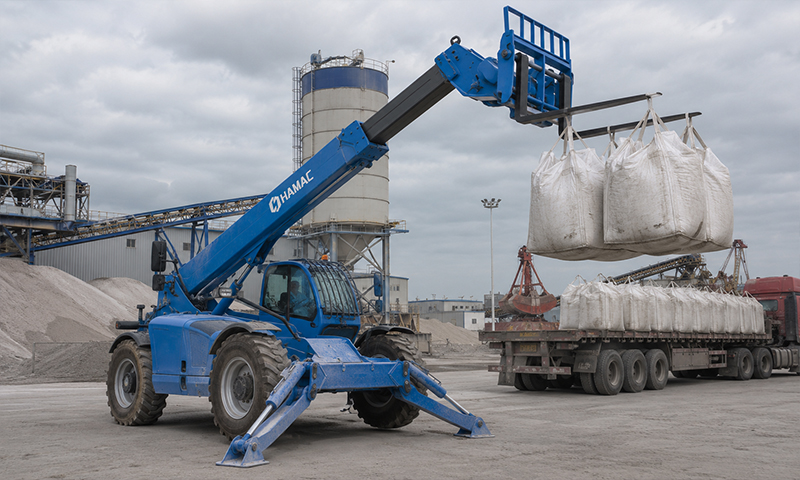
At inland port terminals, a high‑capacity telehandler is used to transfer bulk materials between tr
Free Consultation >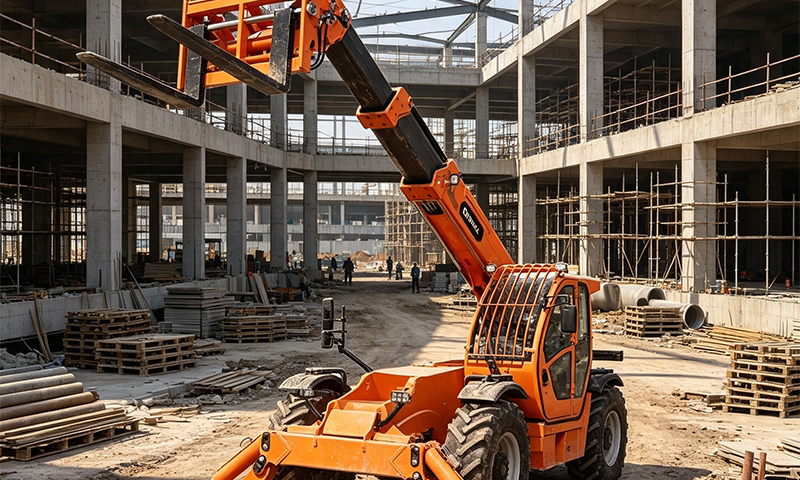
This case study describes how an HT5014 telehandler supports outdoor storage rack replenishment besid
Free Consultation >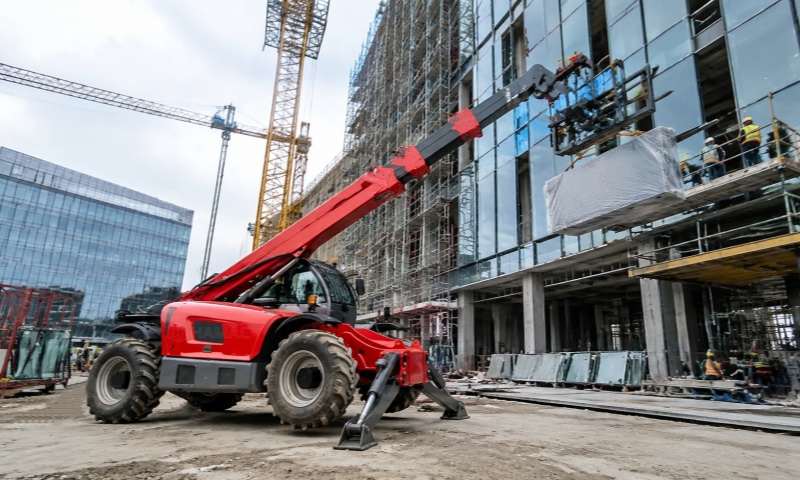
On a commercial building project, an HT4010 telehandler is used to assist facade and curtain wall ins
Free Consultation >Please fill out the form, and we can satisfy any of your needs including equipment selection, scheme design, technical support, or after-sales service. We will contact you as soon as possible.