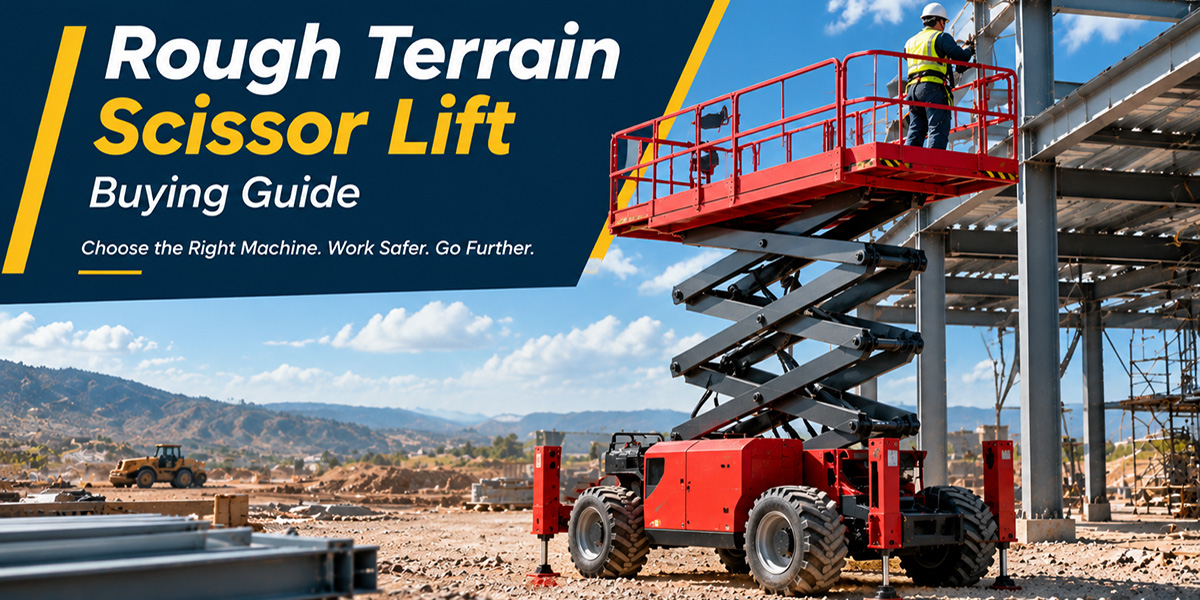
Buying a rough terrain scissor lift for uneven ground jobsites involves more than selecting a model with four-wheel drive. The right machine must reach the work area safely, operate within approved ground and slope limits, carry your full platform load and fit your transport and support arrangements.
This buying guide explains what to check before you order an outdoor scissor lift, whether the equipment is for building construction, steel structure installation, industrial maintenance or a mixed-duty rental fleet.
1. Do You Need a Rough Terrain Scissor Lift or a Slab Model?
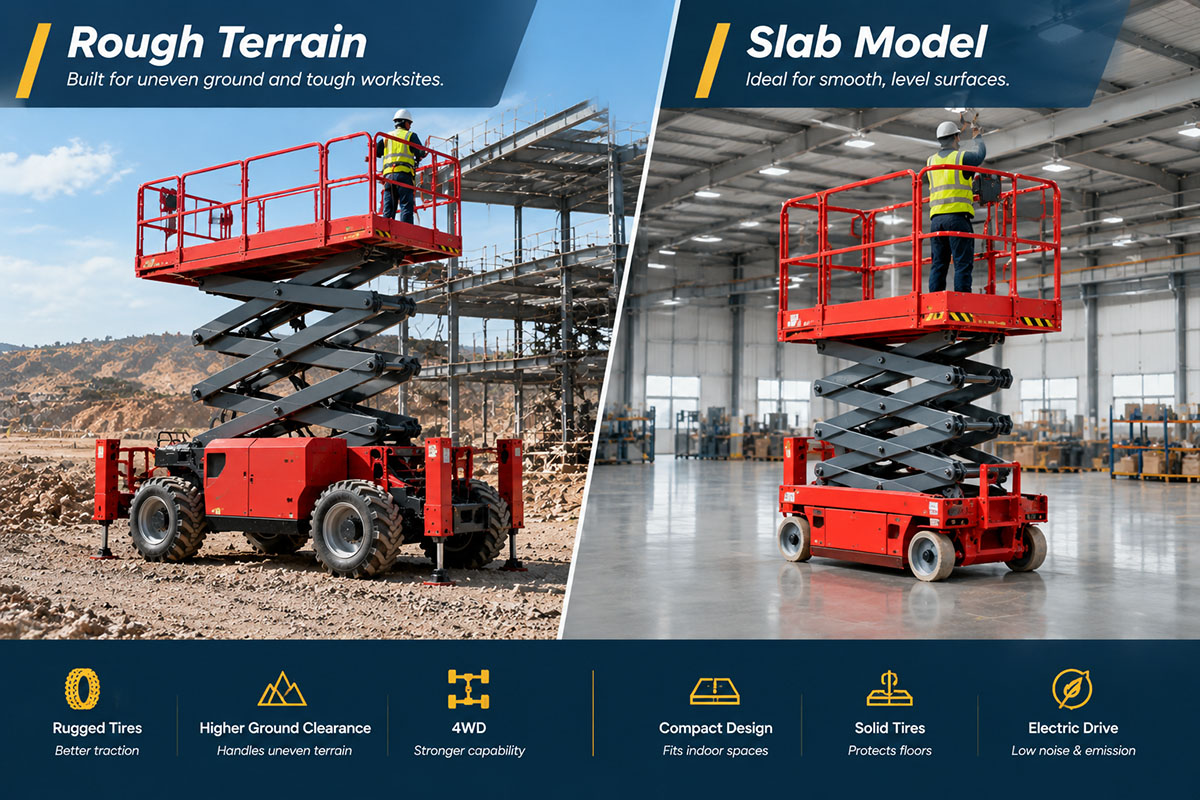
Choose the machine type based on ground conditions rather than whether the equipment will be used outdoors. A slab scissor lift is designed for smooth, level surfaces, while a rough terrain scissor lift is built to travel across construction sites and suitable uneven ground within the manufacturer’s approved limits.
Do not assume that a diesel or outdoor-rated scissor lift automatically meets rough-terrain requirements. Some all-terrain applications use electric-drive machines, and some outdoor models remain unsuitable for soft or unsupported ground. Confirm the model’s intended surface and slope limits before comparing specifications.
2. Can the Ground Support the Machine?
Check scissor lift ground bearing pressure before travel and elevation. The site must support the combined weight of the machine, operators and materials, and individual wheels or outriggers create concentrated loads that differ from the listed platform capacity.
Inspect the full travel route and work area for soft soil, backfilled excavations, underground services, voids and standing water. Ground with poor bearing capacity can affect wheel-supported machines even when outriggers are used, and an outrigger mat does not replace a proper ground assessment. Where needed, consult a competent site engineer before putting the equipment into service.
3. What Do Gradeability, 4WD and Outriggers Mean?
These three terms support different decisions, and they are not interchangeable. Compare them separately before choosing a 4WD scissor lift.
|
Feature |
What It Covers |
What It Does Not Prove |
|
Gradeability |
Travel up a specified slope under stated conditions |
Permission to elevate the platform on that slope |
|
4WD and traction control |
Improved grip across suitable surfaces |
Suitability for soft ground or unsupported soil |
|
Outriggers |
Leveling and support within model limits |
Compliance with ground bearing or slope limits |
Ask the supplier to state whether the quoted scissor lift gradeability applies with the platform stowed and to identify the maximum operating slope. Outrigger requirements must come from the machine’s operating manual, together with the specified support pads. For general background on MEWP site and ground hazards, see the IPAF best practice guidance.
4. What Working Height and Platform Capacity Do You Need?
Match rough terrain scissor lift working height and platform capacity to the actual task. Calculate the total weight of operators, tools and materials, then check the extension-deck limit separately. The following HAMAC models illustrate how height, capacity and gradeability vary across one series.
|
HAMAC Model |
Listed Working Height |
Listed Platform Capacity |
Listed Gradeability |
|
SL1018RE / SL1018RD |
12 m |
450 kg |
35% |
|
SL1323RE / SL1323RD |
15.1 m |
680 kg |
40% |
|
SL1623RE / SL1623RD |
18.2 m |
680 kg |
40% |
Source: HAMAC scissor lift specifications. Use these figures as an initial shortlist, not as a substitute for a final model specification sheet. Gradeability is not a permitted operating slope, and higher platform capacity does not by itself confirm ground suitability.
5. Diesel or Electric Rough Terrain Scissor Lift?
Compare diesel vs electric rough terrain scissor lifts by duty cycle and site support rather than by default. Consider daily operating hours, whether charging or refueling is available on site, local noise and emission limits, and the maintenance arrangement your team can support.
Confirm the drive and lifting systems for the model you are considering, then compare energy supply and maintenance across equivalent machines. Choose the power option after the candidate models meet your ground, access and capacity requirements; selecting the power type first can exclude a more suitable machine.
6. Will It Fit Your Access Route and Transport Plan?
Confirm rough terrain scissor lift dimensions for the full route to the work point, not only the final position. Record the narrowest opening, lowest overhead clearance, required turning space and the clear area needed for outriggers.
Check transport arrangements as part of the purchase. Confirm overall width, stowed height and weight for loading, and ask whether access equipment or alternative machines are required to reach enclosed or restricted areas.
7. What Should You Confirm Before Ordering?
Ask the supplier to confirm the following points in writing before you place an order.
|
Confirmation |
What to Request |
|
Final configuration |
Model, drive arrangement, platform options and accessories |
|
Operating limits |
Travel and elevation slope limits, occupant and load ratings |
|
Outdoor use |
Wind limits, permitted surfaces and required ground support |
|
Documentation |
Operating manual, conformity documents and training plan |
|
Support |
Maintenance schedule, spare parts and warranty coverage |
|
Delivery |
Transport cost, dimensions, schedule and import requirements |
To request a recommendation, send HAMAC your required working height, total platform load, ground and slope conditions, access dimensions and available power supply. Visit the HAMAC scissor lift product page to compare models and submit your project details through the inquiry form.