FD35‑RTS
Rough Terrain Forklifts
Rated load capacity: 3,500 kg
Maximum lift height: 4,500 mm
Consult now






Precast concrete plants and block yards need reliable material-handling equipment to keep production, storage, loading, and delivery operations moving efficiently. Every day, teams may need to unload cement and rebar deliveries, move molds, transport cured blocks, stage precast panels, handle pipe sections, load trucks, and place materials in different areas of an outdoor yard.
A telehandler, also called a telescopic forklift or telescopic handler, is a practical solution for this environment. It combines the lifting function of a forklift with the forward reach of a telescopic boom. This allows operators to pick up loads, travel across the yard, place materials at height, and reach beyond the front wheels where a standard forklift may not be able to work efficiently.
For precast concrete manufacturers, concrete block producers, pipe yards, and building-material depots, a telehandler can improve material flow between the casting area, curing zone, storage yard, loading area, and delivery trucks. The correct machine and attachment selection can help reduce unnecessary manual handling, reduce repeated machine movements, and improve access to materials in busy outdoor work areas.
A telehandler is a material-handling machine with a telescopic boom mounted on a rugged chassis. It can use pallet forks, a bucket, a lifting jib, a crane hook, a work platform, a bale clamp, or other approved attachments depending on the application.
With pallet forks installed, a telehandler works similarly to a forklift. However, its telescopic boom can extend forward and upward, giving the operator more reach than a conventional forklift. This makes it especially useful for placing materials on elevated platforms, over obstacles, into truck beds, behind stacks, or in areas with limited direct access.
Telehandlers are widely used in construction, concrete production, agriculture, warehousing, industrial maintenance, and building-material distribution. Pallet forks are among the most common telehandler attachments because they can be adjusted to suit different pallet widths and load dimensions.
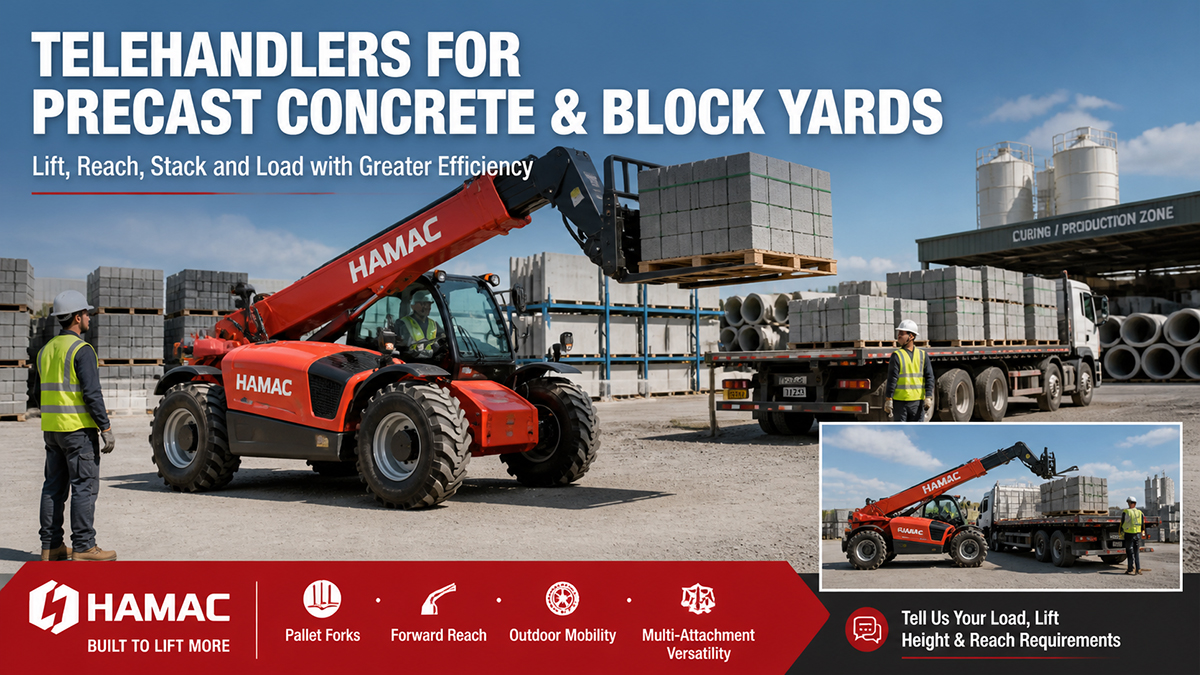
Precast concrete and block yards are usually outdoor or semi-outdoor working environments. Ground conditions can include compacted soil, gravel, partially paved areas, concrete production floors, temporary storage zones, and busy loading lanes. Materials are heavy, repetitive, and often stored at different heights or in multiple locations.
A telehandler is designed to work across these changing conditions. It can move from the casting line to the curing area, travel to outdoor storage, load a delivery truck, and place materials onto a raised platform with one machine. This flexibility makes it useful where a standard forklift has limited reach and where a crane may be too slow or expensive for frequent short-distance lifting tasks.
| Yard Requirement | How a Telehandler Helps |
|---|---|
| Unload incoming material trucks | Uses pallet forks to unload cement bags, palletized components, rebar bundles, molds, and equipment. |
| Move heavy products across the yard | Travels between production, curing, storage, and loading zones on approved outdoor surfaces. |
| Stack concrete blocks and pallets | Uses forward reach and lifting height to place loads in organized storage rows. |
| Load finished products onto trucks | Reaches into flatbed trucks or trailers and positions products accurately. |
| Place materials at elevated locations | Extends the boom to deliver pallets, components, or equipment onto decks and platforms. |
| Work around obstacles and stored products | Provides forward reach where a conventional forklift cannot approach closely. |
| Support several daily applications | Can use different approved attachments for forks, buckets, hooks, and specialized handling tasks. |
A telehandler can support many routine handling tasks in a precast concrete yard. The machine capacity, attachment, fork length, load center, boom reach, and ground condition must always match the actual load and the work plan.
| Material or Equipment | Typical Telehandler Task | Important Consideration |
|---|---|---|
| Concrete block pallets | Move and stack cured block pallets in storage and loading areas. | Confirm pallet condition, load weight, stack height, and fork spacing. |
| Precast concrete panels | Transport panels from curing zones to storage areas or truck loading points. | Use a suitable attachment and lifting method designed for the panel configuration. |
| Concrete pipes | Move pipe sections, fittings, and packaged drainage components. | Assess pipe diameter, length, weight, stability, and approved handling attachment. |
| Palletized cement or additives | Unload trucks and deliver materials to the production area. | Keep pallets level and verify the rated lifting capacity. |
| Rebar bundles | Transport reinforcement steel from storage to fabrication or casting stations. | Use appropriate fork length and secure the load before traveling. |
| Formwork and molds | Move steel molds, formwork frames, and casting accessories. | Check load center, attachment capacity, and required placement accuracy. |
| Equipment pallets | Move tools, spare parts, welding equipment, and maintenance materials. | Ensure the load is stable and correctly palletized. |
| Sand, gravel, and loose materials | Load and move loose materials with a suitable bucket attachment. | Use only approved buckets and respect hydraulic and load limits. |
Concrete blocks and masonry units are dense loads. A full pallet can be heavy, and block-yard operations often require repeated travel between production, storage, and truck-loading areas. The telehandler provides a combination of lift capacity, outdoor mobility, and reach that can support this workflow.
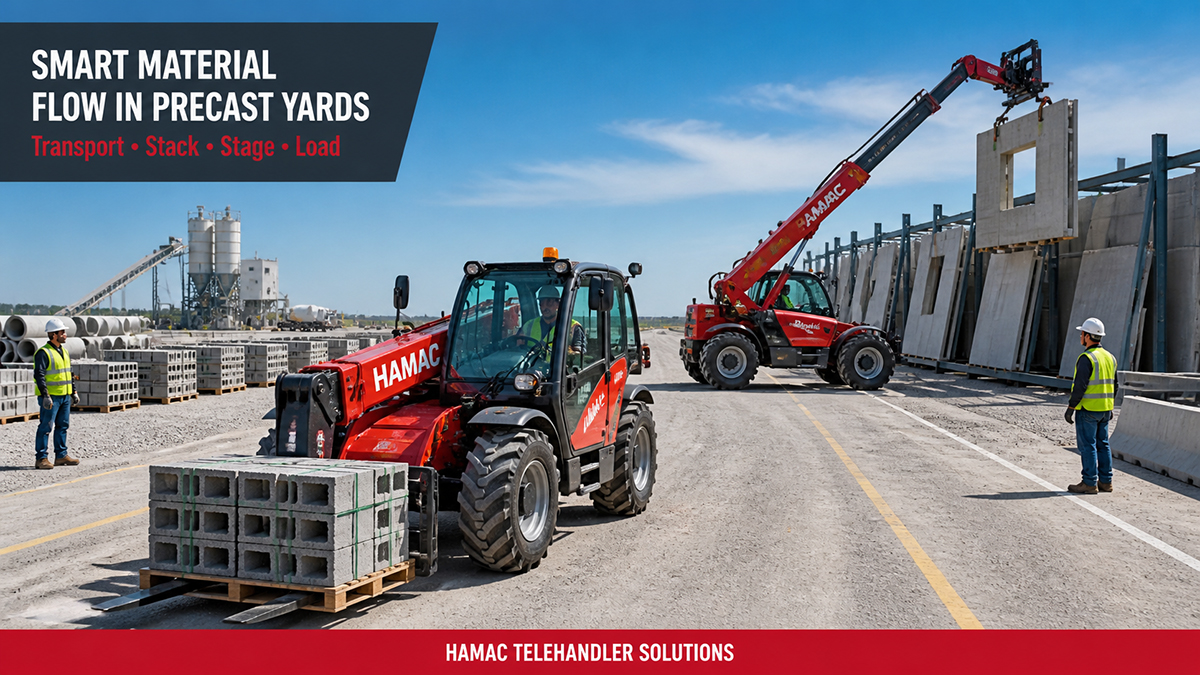
| Telehandler Advantage | Benefit for Block Yards |
|---|---|
| Telescopic forward reach | Allows operators to place block pallets further into storage rows or truck beds. |
| Lift height | Supports organized stacking and elevated placement where required. |
| Rugged outdoor mobility | Helps the machine travel between different yard zones on approved rough or partially paved surfaces. |
| Adjustable pallet forks | Allow operators to adapt fork spacing to different pallet widths and load sizes. |
| High visibility cab design | Helps operators monitor the load, travel route, workers, vehicles, and storage area. |
| Multi-attachment capability | Allows one machine to support forks, buckets, hooks, jibs, and other approved attachments. |
| Truck loading capability | Helps position finished block pallets and precast products onto delivery vehicles. |
For standard palletized blocks, adjustable pallet forks are usually the starting attachment. For unpalletized or specially strapped products, the handling method may require block forks, clamps, lifting beams, fork pockets, cast-in lifting anchors, or another application-specific solution.
Precast panels, concrete pipes, manhole components, and other large concrete products require more careful planning than standard block pallets. These loads may have irregular shapes, long dimensions, high weight, specific lifting points, and different center-of-gravity positions.
A telehandler can be effective for moving and placing these products when the attachment, capacity, boom reach, and load chart are correctly matched. However, some large panels, long pipe sections, or heavy structural components may require a crane, spreader beam, lifting beam, specialized clamp, or dedicated handling system.
| Precast Product | Potential Handling Method | Selection Priority |
|---|---|---|
| Palletized concrete blocks | Pallet forks or block forks | Capacity, fork spacing, pallet integrity, storage layout |
| Precast panels | Approved lifting jib, hook attachment, spreader arrangement, or dedicated attachment | Certified lifting points, panel weight, center of gravity, boom load chart |
| Concrete pipes | Pipe-handling attachment, forks with approved supports, or lifting attachment | Pipe diameter, length, rolling risk, secure load control |
| Manhole rings and chambers | Forks, lifting hook, or dedicated lifting attachment | Approved lifting points, secure placement, load stability |
| Formwork frames | Pallet forks, fork positioner, or lifting jib | Frame dimensions, load center, lifting height, placement accuracy |
| Rebar cages and steel bundles | Long forks, fork extensions where approved, or lifting jib | Load length, bundling method, route safety, visibility |
When handling large or irregular precast products, always confirm that the telehandler’s rated capacity remains sufficient at the actual boom extension and lift height. A telehandler’s available capacity decreases as the boom extends forward or upward, so operators must follow the machine load chart and the attachment-specific capacity information.
The telescopic boom is the main feature that separates a telehandler from a conventional forklift. A standard forklift needs to drive close to the load and close to the placement point. A telehandler can often position the load from a greater distance, which is useful in busy precast yards where stacks, trucks, curing racks, molds, barriers, or uneven ground limit direct machine access.
For example, a telehandler can unload block pallets from one side of a truck, then extend the boom to place the pallets into the required storage row. It can also deliver rebar bundles or formwork components onto a raised work deck without requiring a separate crane for every small lifting task.
| Work Situation | How Reach Helps |
|---|---|
| Loading a flatbed truck | Allows the operator to place materials farther onto the truck bed without repeated repositioning. |
| Stacking finished block pallets | Supports organized storage placement while keeping travel lanes clear. |
| Placing materials behind barriers or stacks | Reaches beyond an obstacle when direct forklift access is limited. |
| Supplying elevated work areas | Delivers materials onto scaffolding, decks, platforms, or upper construction levels. |
| Working beside curing or casting zones | Allows material placement without driving too close to sensitive production areas. |
Telehandler selection should begin with the actual materials and work sequence in the yard. Buyers should not choose a model only by its maximum rated capacity. The required capacity at the intended lift height and boom reach is more important than the nominal capacity at a short load center.
| Selection Factor | Questions to Ask |
|---|---|
| Maximum load weight | What is the heaviest block pallet, panel, pipe, mold, rebar bundle, or equipment load? |
| Required lift height | How high must the load be lifted for storage, truck loading, or elevated placement? |
| Required forward reach | How far must the load be placed beyond the front wheels? |
| Actual load center | How far is the load center from the fork face or attachment carriage? |
| Attachment requirement | Do you need pallet forks, a bucket, a lifting jib, a hook, a pipe attachment, or another tool? |
| Ground condition | Will the machine work on concrete, gravel, compacted soil, uneven yard areas, or slopes? |
| Travel route | Are there tight corners, storage stacks, truck lanes, ramps, or restricted access points? |
| Daily operating hours | Will the telehandler support occasional loading or continuous production-yard logistics? |
| Service support | Are spare parts, filters, maintenance supplies, and technical support available for the project location? |
For example, a compact telehandler may be suitable for handling light block pallets and materials at moderate height. A larger machine with higher capacity and longer boom reach may be required for dense concrete products, elevated placement, wide storage rows, heavy rebar bundles, formwork frames, or precast components.
One of the main advantages of a telehandler is attachment versatility. The same machine can perform several tasks if suitable and approved attachments are used. Every attachment affects the machine’s capacity and operating characteristics, so operators must use the applicable load chart and attachment information.
| Attachment | Typical Yard Application |
|---|---|
| Pallet forks | Handling block pallets, cement, bagged materials, molds, equipment pallets, and general construction supplies. |
| Fork positioner | Adjusting fork spacing for different pallet widths, skids, molds, and building-material packs. |
| Side shift carriage | Improving left-right positioning accuracy when loading trucks or placing materials in storage rows. |
| Bucket | Handling loose sand, gravel, aggregate, debris, or other bulk materials. |
| Lifting jib or hook attachment | Lifting selected precast accessories, formwork components, steel materials, and approved suspended loads. |
| Pipe-handling attachment | Moving pipe sections or cylindrical concrete products when correctly matched to the load. |
| Work platform | Supporting approved elevated maintenance or installation work where local regulations and machine approvals allow. |
Concrete products are heavy, dense, and sometimes irregular. Safe handling requires trained operators, clear traffic routes, stable ground, correct attachments, proper load identification, and compliance with the telehandler manufacturer’s load chart.
Before lifting any load, the operator should confirm the load weight, check the attachment, inspect the forks or lifting device, verify the intended lift height and reach, and make sure the travel route is clear. Loads should be kept low during travel whenever practical, especially on uneven ground or when moving between yard zones.
| Safe Handling Practice | Reason |
|---|---|
| Confirm the actual load weight | Prevents lifting beyond the telehandler’s rated capacity. |
| Check the load chart | Confirms available capacity at the actual boom extension and lift height. |
| Inspect pallets and straps | Helps prevent concrete blocks or materials from shifting during travel. |
| Use the correct attachment | Improves load security and placement accuracy. |
| Keep the load low while traveling | Helps maintain stability and improves operator visibility. |
| Travel slowly on uneven ground | Reduces shock loading, material damage, and loss-of-control risks. |
| Maintain exclusion zones | Keeps workers clear of suspended, moving, or unstable loads. |
| Use a spotter when necessary | Supports safe movement near trucks, storage stacks, blind areas, and workers. |
| Perform daily inspections | Helps identify hydraulic leaks, tire damage, fork wear, brake issues, and other faults before operation. |
Both telehandlers and rough terrain forklifts are valuable in concrete and block yards. The best choice depends on whether the main requirement is ground-level material transport or forward-and-upward placement at reach.
| Requirement | Telehandler | Rough Terrain Forklift |
|---|---|---|
| Move heavy pallets across the yard | Suitable, especially where reach is also required. | Highly suitable for repeated ground-level transport. |
| Place materials at height | Strong advantage because of telescopic boom lift height. | Limited by conventional mast lift height. |
| Reach over obstacles or into truck beds | Strong advantage because of forward reach. | Limited forward reach beyond the forks. |
| Handle repetitive dense pallet loads | Suitable when capacity and load chart match the task. | Often highly efficient for ground-level heavy pallet movement. |
| Use multiple attachments | Highly versatile with forks, buckets, jibs, hooks, and other approved tools. | Can use attachments but usually has less lift-and-reach versatility. |
| Operate in tight storage lanes | Depends on model dimensions and turning radius. | May be more practical for some ground-level yard layouts. |
Many larger precast operations use both machines. A rough terrain forklift can handle repetitive transport of heavy pallets and concrete products at ground level, while a telehandler can place selected materials at height, over barriers, onto truck beds, or onto elevated work areas.
Yes. A telehandler with pallet forks can lift and transport concrete block pallets when the load is within the machine’s rated capacity at the required lift height and boom reach. The pallet condition, block weight, fork spacing, load center, ground condition, and load chart must be checked before lifting.
A telehandler can handle some precast panels when the correct approved attachment, lifting method, capacity, and load chart are used. Large, heavy, long, or irregular panels may require a crane, lifting beam, spreader beam, or dedicated precast handling system.
Pallet forks are generally suitable for palletized concrete blocks. For unpalletized blocks, strapped units, slabs, curbs, or other special products, block forks, clamps, lifting beams, or other application-specific attachments may be required.
A telehandler provides forward reach and lift height in addition to forklift-style material handling. This makes it useful for placing materials beyond the front wheels, onto elevated areas, into truck beds, behind storage stacks, or around yard obstacles.
Yes. The available lifting capacity normally decreases as the boom extends forward or upward. Operators must always follow the machine load chart and confirm capacity at the actual lift height, reach, attachment configuration, and load center.
Many telehandlers are designed for outdoor construction and yard environments with suitable tires, ground clearance, and drive systems. However, the machine must only operate within its approved limits for slope, terrain, ground condition, load, and boom position.
A telehandler can perform many forklift and light lifting tasks, especially where reach is required. However, it does not replace every forklift or crane application. Repetitive heavy ground-level transport may be better suited to a rough terrain forklift, while heavy suspended loads, long-radius lifting, and large precast elements may require a crane.
HAMAC telehandlers can support material handling in precast concrete plants, block yards, building-material depots, pipe yards, construction sites, and industrial projects. With the right capacity, boom reach, drive configuration, and attachment, a telehandler can help move blocks, pallets, molds, rebar, pipes, equipment, and precast components more efficiently.
Send us your maximum load weight, required lift height, forward reach, material type, attachment requirement, ground condition, yard layout, and daily operating needs. Our team can recommend a suitable telehandler model and provide technical specifications, attachment options, product brochures, container-loading information, and a quotation.
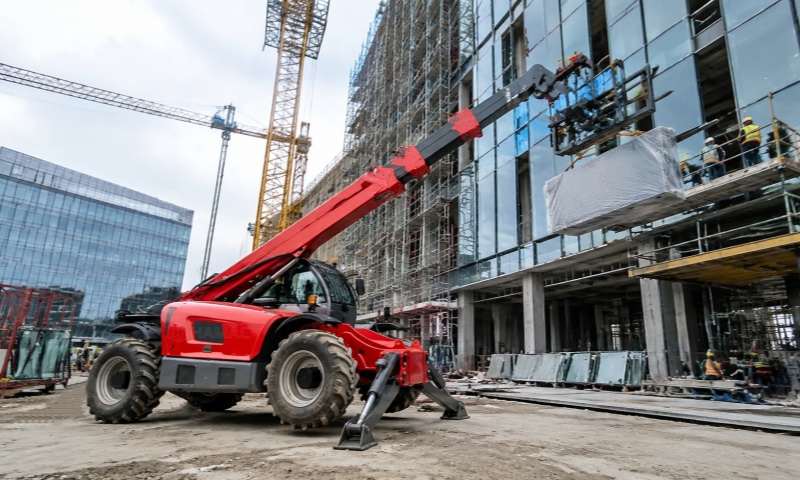
On a commercial building project, an HT4010 telehandler is used to assist facade and curtain wall ins
Free Consultation >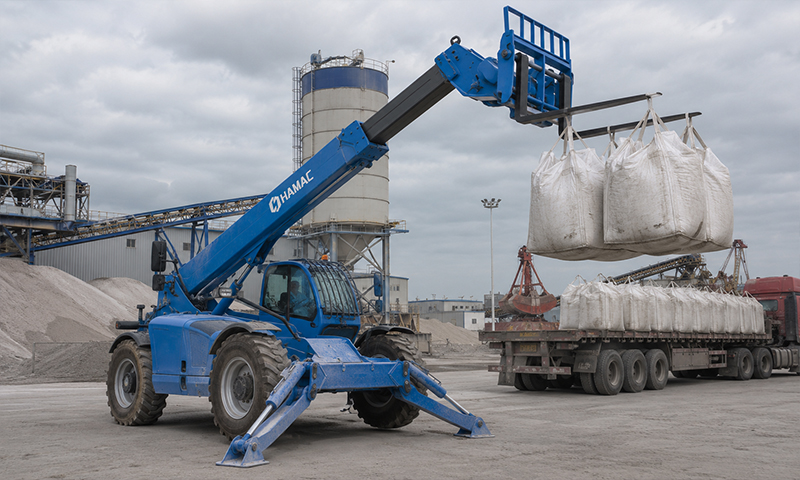
At inland port terminals, a high‑capacity telehandler is used to transfer bulk materials between tr
Free Consultation >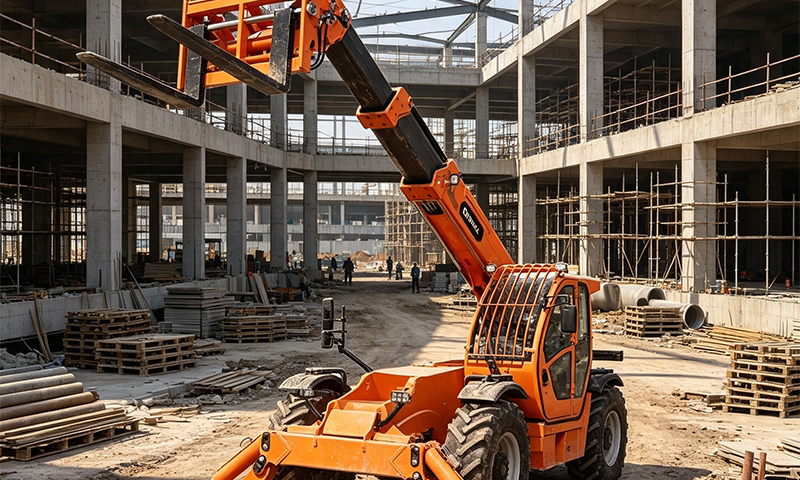
This case study describes how an HT5014 telehandler supports outdoor storage rack replenishment besid
Free Consultation >Please fill out the form, and we can satisfy any of your needs including equipment selection, scheme design, technical support, or after-sales service. We will contact you as soon as possible.