Vertical Lifts
Aerial Work Platforms
Max Working Height:5.8–10.3 m
Platform Capacity:160–227 kg
Consult now






Pipeline construction projects require more than excavation equipment, welding machines, and pipe-laying crews. Contractors also need reliable material-handling equipment to move pipe sections, fittings, welding units, generators, cable drums, equipment pallets, tools, and construction supplies along long and often difficult project corridors.
A rough terrain forklift is designed for this type of work. Compared with a standard warehouse forklift, it has larger pneumatic tires, higher ground clearance, a stronger chassis, and better traction for unpaved or uneven ground. These features make it a practical solution for pipeline projects in remote areas, desert sites, rural infrastructure zones, mountainous regions, industrial developments, and oil and gas construction projects.
Whether the project involves water pipelines, gas pipelines, oil pipelines, irrigation systems, utility networks, or industrial pipe installation, the right rough terrain forklift can improve site logistics, reduce manual handling, and support safer material movement between storage yards, delivery points, welding stations, trench areas, and installation fronts.
Pipeline projects are often spread across long distances. Materials may be delivered to a central laydown yard and then transported to different work fronts as excavation, welding, coating, lifting, testing, and backfilling progress. Roads may be temporary, narrow, uneven, dusty, muddy, or unfinished.
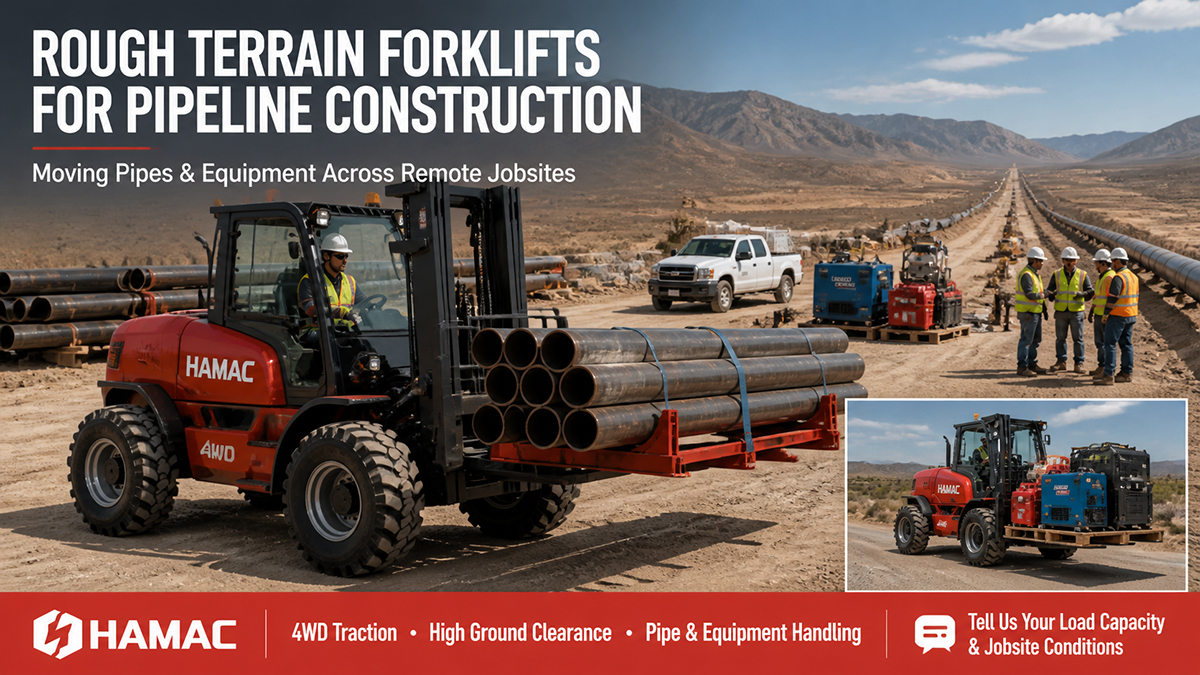
Standard forklifts are mainly designed for smooth and level surfaces such as warehouse floors, paved yards, and indoor logistics areas. They may struggle on gravel, loose soil, sand, mud, rutted access roads, slopes, and construction debris. A rough terrain forklift is built to operate in these more demanding environments.
| Pipeline Jobsite Challenge | How a Rough Terrain Forklift Helps |
|---|---|
| Long distance between material storage and work fronts | Moves pipe sections, pallets, tools, and equipment efficiently along project routes. |
| Uneven or unpaved access roads | Large pneumatic tires and higher ground clearance improve travel capability. |
| Heavy pipe sections and pipe bundles | Rated lifting capacity supports controlled handling of approved loads. |
| Remote work locations | Diesel power supports work away from fixed electrical infrastructure. |
| Changing site conditions | Rugged chassis and outdoor-oriented design suit active construction environments. |
| Multiple work activities in one corridor | Supports welding teams, pipe crews, excavation teams, maintenance staff, and logistics personnel. |
A rough terrain forklift can support many material-handling tasks on a pipeline project. The exact lifting method, fork attachment, capacity, and route plan should be selected according to the dimensions, weight, center of gravity, and condition of each load.
| Material or Equipment | Typical Handling Task | Important Consideration |
|---|---|---|
| Pipe sections | Move pipe from storage areas to welding, alignment, or trench-side locations. | Confirm pipe weight, length, diameter, load stability, and correct attachment. |
| Pipe bundles | Transport bundled pipes from delivery points to temporary storage or installation areas. | Ensure the bundle is secured and within rated capacity. |
| Pipe fittings and valves | Move elbows, flanges, valves, reducers, couplings, and packaged accessories. | Use pallets, stillages, or suitable containers to prevent shifting. |
| Welding equipment | Transport welders, welding consumables, power units, and support equipment. | Secure equipment before travel on rough ground. |
| Generators and compressors | Move equipment between work areas or temporary service stations. | Check machine weight, lifting points, and load center. |
| Cable drums | Transport cable drums for utility, communication, and pipeline monitoring work. | Use appropriate drum-handling attachments where required. |
| Equipment pallets | Move spare parts, tools, fasteners, safety supplies, and packaged materials. | Keep the load stable and within the forklift’s load chart. |
| Skids and fabricated components | Position project equipment close to the installation area. | Consider dimensions, load center, route condition, and lifting capacity. |
A rough terrain forklift used for pipeline construction should be selected according to actual site conditions and material-handling requirements. Capacity alone is not enough. The machine must also provide appropriate traction, stability, visibility, ground clearance, and serviceability for the project environment.
| Feature | Why It Matters for Pipeline Construction |
|---|---|
| Rated lifting capacity | Must safely handle the heaviest expected pipe, equipment pallet, welding unit, or project material. |
| 4WD drive system | Improves traction on gravel, dirt, sand, mud, and uneven temporary access roads. |
| Large pneumatic tires | Support travel over rough surfaces and provide better shock absorption than solid indoor tires. |
| High ground clearance | Helps reduce undercarriage contact with stones, ruts, debris, and uneven ground. |
| Diesel engine | Provides practical outdoor power for remote work areas without fixed charging infrastructure. |
| Strong mast and carriage | Supports stable lifting and controlled load handling in demanding conditions. |
| Wide visibility mast design | Helps the operator see the load, route, work crew, trench area, and surrounding hazards. |
| Hydraulic steering and reliable braking | Supports controlled maneuvering and stopping on approved terrain and work routes. |
| Side shift option | Helps operators fine-tune load positioning without repeated forklift repositioning. |
| Fork positioner option | Allows faster adjustment to different pallet widths, equipment skids, and material dimensions. |
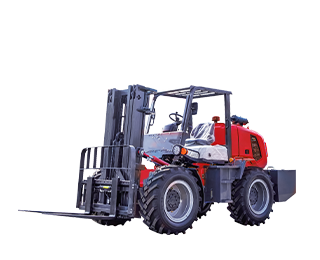
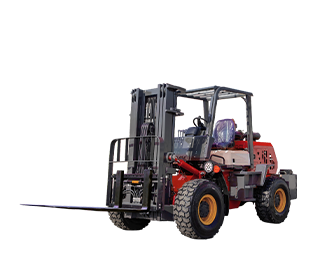
For example, HAMAC’s FD60-RT rough terrain forklift is used on remote infrastructure and utility projects to move pipe sections, equipment pallets, and materials between delivery points, temporary storage zones, and work fronts. Its 6,000 kg rated capacity, diesel 4WD drivetrain, high ground clearance, and deep-tread pneumatic tires are configured for challenging surfaces such as gravel, soft soil, and sloped terrain. [103]
A standard warehouse forklift and a rough terrain forklift may appear similar at first, but they are designed for very different operating environments. A warehouse forklift is optimized for flat, clean, hard surfaces and frequent movement in narrow indoor aisles. A rough terrain forklift is optimized for outdoor construction conditions, uneven ground, and heavier-duty logistics work.
| Feature | Standard Warehouse Forklift | Rough Terrain Forklift |
|---|---|---|
| Typical operating area | Warehouses, factories, paved yards, logistics centers | Construction sites, pipeline corridors, gravel yards, remote projects |
| Ground condition | Smooth, hard, level surfaces | Uneven, unpaved, loose, rough, or sloped surfaces within machine limits |
| Tires | Solid tires or cushion tires | Large pneumatic tires with stronger traction |
| Ground clearance | Lower ground clearance | Higher ground clearance for debris and uneven terrain |
| Drive system | Usually optimized for hard indoor surfaces | Often equipped with 4WD or stronger outdoor traction capability |
| Power source | Electric battery, LPG, gasoline, or diesel depending on model | Commonly diesel for outdoor and remote operations |
| Best use | Pallet handling and indoor logistics | Construction materials, pipe sections, equipment pallets, and remote site logistics |
Rough terrain forklifts are purpose-built for outdoor material handling on uneven or uncompacted surfaces. Their design commonly includes larger pneumatic tires, stronger chassis construction, high ground clearance, and improved traction for difficult jobsite conditions.
When selecting a forklift for pipeline construction, capacity should be based on the heaviest actual load, not only on the average pipe weight. The operator and project manager must also consider pipe length, pipe diameter, bundle configuration, load center, fork length, attachment weight, route condition, and required lifting height.
A long pipe or oversized fabricated component can reduce effective lifting capacity because the load center moves farther away from the fork face. The farther the load center is from the forklift, the greater the stability effect on the machine. Always use the manufacturer’s load chart and confirm the capacity at the actual load center and lift height.
| Selection Factor | Why It Is Important |
|---|---|
| Pipe weight | Confirms the minimum lifting capacity required for each pipe section or bundle. |
| Pipe length | Longer loads may require special handling, route planning, and extra operator control. |
| Pipe diameter | Affects load stability, handling method, and attachment requirements. |
| Load center | Changes the available lifting capacity and must match the forklift load chart. |
| Required lift height | Capacity can change at different mast heights and lifting stages. |
| Attachment weight | Pipe clamps, booms, fork positioners, and other attachments affect net capacity. |
| Ground condition | Soft, sloped, or uneven ground requires additional stability planning and safer travel practices. |
| Travel distance | Long site routes affect fuel planning, operator fatigue, traffic control, and maintenance needs. |
Standard forks can be suitable for some palletized materials and properly secured pipe bundles. However, individual pipes, round loads, oversized components, and special pipeline equipment may require dedicated attachments or handling methods.
| Attachment or Accessory | Typical Use |
|---|---|
| Fork positioner | Adjusts fork spacing for different pallet sizes, skids, and material widths. |
| Side shift | Allows precise left-right load positioning without moving the entire forklift. |
| Pipe clamp | Helps grip and handle selected pipe types when correctly specified for the load. |
| Carpet pole or boom attachment | May be used for certain cylindrical loads when designed and approved for the application. |
| Long forks | Support longer pallets, skids, or properly secured material bundles. |
| Load backrest extension | Helps support certain tall or unstable palletized loads. |
| Warning lights and work lights | Improve visibility during early-morning, late-afternoon, dusty, or low-light work. |
Any attachment changes the forklift’s operating characteristics and may reduce available capacity. Only use attachments approved for the forklift model and the intended load. The revised capacity information must be available to the operator before work begins.
Pipeline materials can be heavy, long, round, awkward, and difficult to control. Safe handling requires proper planning, trained operators, correct attachments, stable ground, clear communication, and strict respect for forklift capacity limits.
| Safe Practice | Why It Matters |
|---|---|
| Confirm the load weight | Prevents lifting loads that exceed the forklift’s rated capacity. |
| Check the load center | Ensures that actual capacity matches the pipe or equipment configuration. |
| Use the correct attachment | Helps prevent pipe rolling, shifting, slipping, or load damage. |
| Inspect the route before travel | Identifies mud, soft soil, steep slopes, trenches, debris, and other hazards. |
| Keep the load low during travel | Helps maintain stability and visibility while moving across the jobsite. |
| Travel slowly on rough ground | Reduces shock loading, load movement, and the risk of loss of control. |
| Use a spotter where necessary | Improves communication near trenches, structures, workers, vehicles, and restricted areas. |
| Keep personnel clear of the load | Reduces exposure to suspended loads, pinch points, and rolling-pipe hazards. |
| Inspect equipment daily | Helps identify tire wear, hydraulic leaks, fork damage, brake issues, and mast problems before operation. |
Before lifting pipes or related equipment, teams should confirm the load weight, verify equipment capacity, inspect lifting tools and attachment condition, establish communication procedures, and keep personnel clear of suspended loads and pinch points. Sudden starts, stops, and shock loading should be avoided, especially on uneven ground.
Remote pipeline projects require careful logistics planning because fuel, spare parts, service technicians, and replacement equipment may not be immediately available. Selecting a reliable and serviceable rough terrain forklift can help reduce downtime in locations where machine support is difficult to access.
Project teams should define travel routes between delivery points, pipe storage areas, welding stations, trench sections, and temporary site facilities. These routes should be assessed regularly because ground conditions can change after rain, excavation activity, truck movements, or heavy equipment traffic.
| Remote Site Planning Item | Recommended Action |
|---|---|
| Material laydown area | Prepare a stable storage zone with organized pipe, fittings, pallets, and equipment locations. |
| Forklift travel route | Plan routes that avoid deep ruts, unstable slopes, open trenches, and congested work areas. |
| Fuel supply | Plan diesel supply and refueling procedures for remote operating locations. |
| Daily inspection | Check tires, forks, mast, hydraulics, brakes, steering, lights, and visible structural components. |
| Spare parts support | Prepare critical wear parts and maintenance supplies according to machine usage and site distance. |
| Operator communication | Use radios, hand signals, spotters, and clear work-zone rules where visibility is limited. |
| Weather planning | Adjust work routes and travel speed for rain, mud, strong wind, dust, heat, and low visibility. |
On remote utility and infrastructure projects, a 6-ton rough terrain forklift can support the movement of pipe sections, equipment pallets, cable drums, welding machines, and construction supplies between delivery areas and active work fronts.
For a pipeline project, the forklift may first unload packaged materials at a temporary laydown yard. It can then deliver selected pipe sections and fittings to the welding crew, transport equipment pallets to the trench area, and move cable drums or generators to utility installation points. This creates a more organized material flow and helps reduce unnecessary manual handling or dependence on multiple machines for small and medium material movements.
For long, heavy, or unusual pipe loads, the contractor should still evaluate whether a dedicated pipe handler, telehandler, crane, sideboom, or another lifting solution is more appropriate. Equipment selection must always match the actual load, lift plan, route, and project safety procedure.
Yes, a rough terrain forklift can handle properly secured pipe sections, bundles, fittings, and related project materials when the load is within the rated capacity and handled with suitable forks or approved attachments. Pipe length, diameter, weight, load center, ground conditions, and travel route must be evaluated before operation.
Rough terrain forklifts are designed for outdoor construction conditions such as gravel, dirt, mud, soft soil, slopes, and uneven access routes. They usually have larger pneumatic tires, higher ground clearance, stronger chassis construction, and better traction than standard warehouse forklifts.
The correct capacity depends on the heaviest load, actual load center, pipe length, attachment weight, required lift height, and site conditions. A 3-ton, 5-ton, 6-ton, or larger rough terrain forklift may be appropriate depending on the project. Always select capacity using the manufacturer’s load chart rather than only the nominal forklift rating.
Rough terrain forklifts are designed for challenging outdoor surfaces, but no forklift should be used beyond its traction, slope, ground-pressure, and operating limits. Extremely soft sand, deep mud, unstable ground, or steep slopes may require route improvement, ground mats, a different machine, or another handling method.
Depending on the pipe type and project requirements, suitable options may include fork positioners, side shift, pipe clamps, boom attachments, long forks, or other approved handling tools. The attachment must be correctly matched to the forklift and load, and its weight must be included when calculating available lifting capacity.
The load should generally be carried as low as practical while maintaining sufficient ground clearance and visibility. Keeping the load low helps improve stability, especially when traveling over uneven ground. Always follow the manufacturer’s operating manual and site safety procedures.
Not always. A rough terrain forklift is highly effective for ground-level material transport, pallet handling, pipe bundles, and equipment movement across
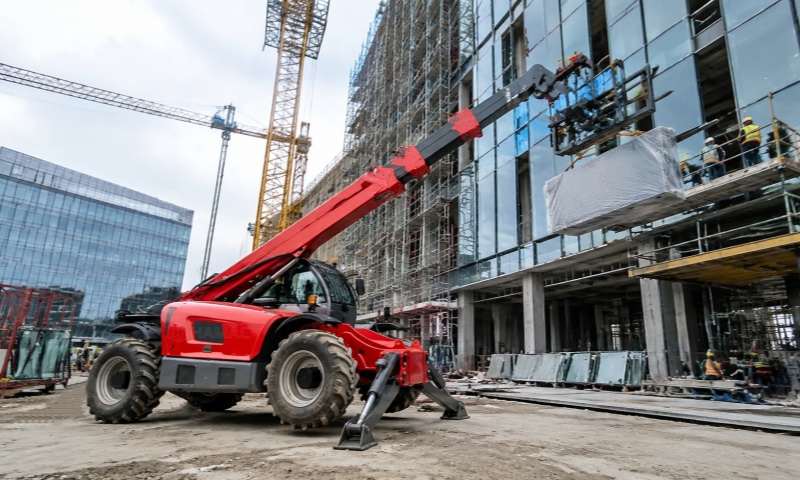
On a commercial building project, an HT4010 telehandler is used to assist facade and curtain wall ins
Free Consultation >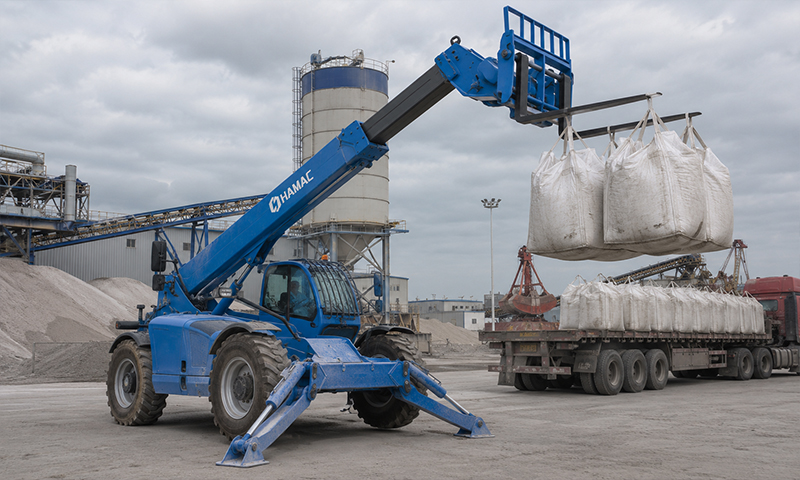
At inland port terminals, a high‑capacity telehandler is used to transfer bulk materials between tr
Free Consultation >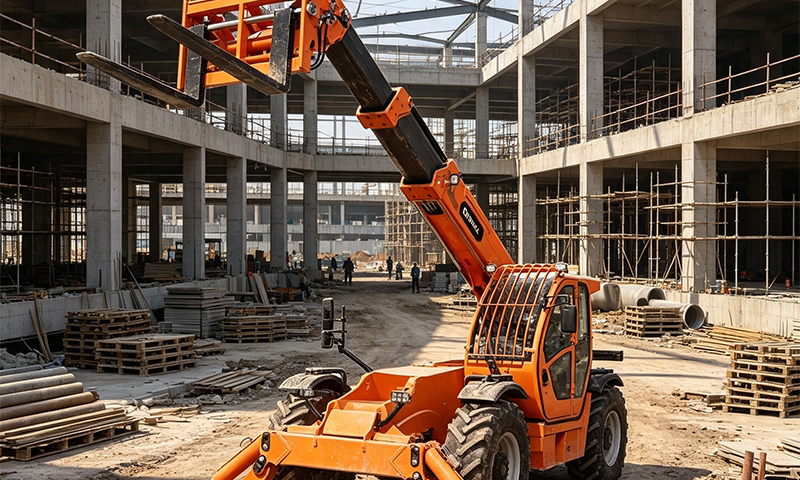
This case study describes how an HT5014 telehandler supports outdoor storage rack replenishment besid
Free Consultation >Please fill out the form, and we can satisfy any of your needs including equipment selection, scheme design, technical support, or after-sales service. We will contact you as soon as possible.