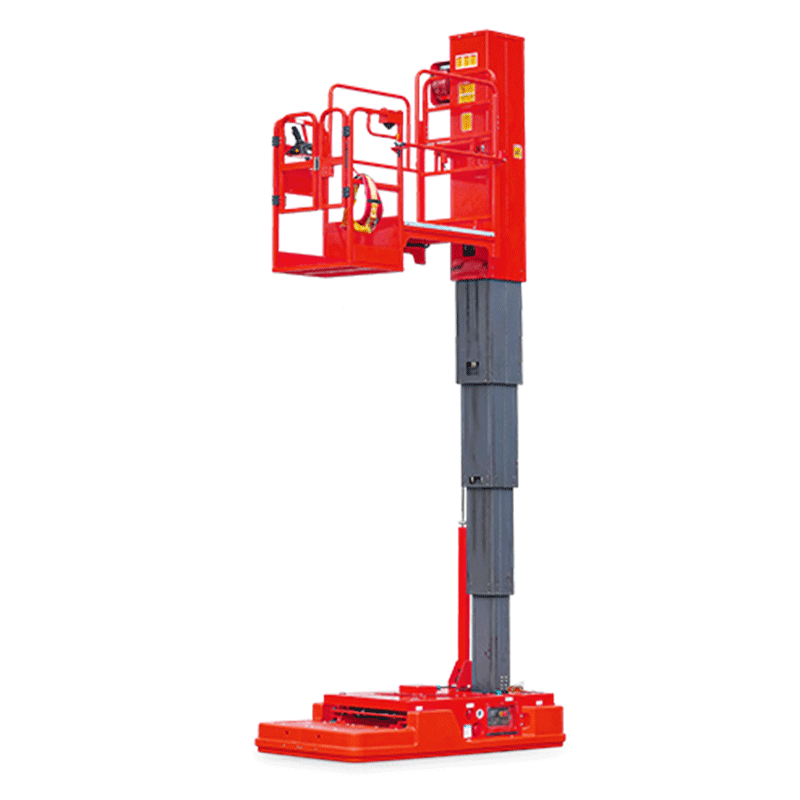
Vertical Lifts
Aerial Work Platforms
Max Working Height:5.8–10.3 m
Platform Capacity:160–227 kg
Consult now






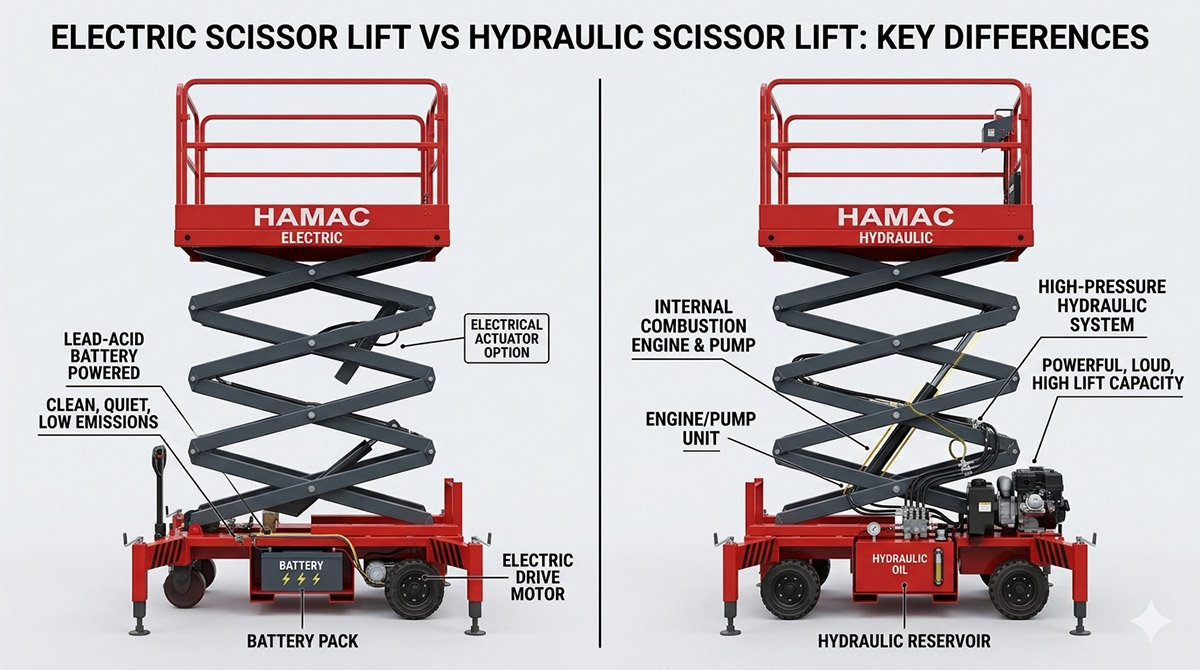
Electric scissor lifts and hydraulic scissor lifts are both designed to raise people, tools, or materials vertically. However, the names can be confusing because many electric scissor lifts also use hydraulic cylinders to lift the platform. The real difference is usually not simply “electric versus hydraulic,” but the machine’s power source, travel capability, intended load, and application.
In most access-equipment projects, an electric scissor lift is a battery-powered, self-propelled platform for workers performing tasks at height. It is commonly used in warehouses, factories, shopping malls, airports, workshops, and indoor construction projects. A hydraulic scissor lift often refers to a stationary or mobile hydraulic lift table used to raise goods, pallets, components, or materials to an ergonomic working height.
Both solutions can use a scissor mechanism and hydraulic lifting system. The best choice depends on whether your project needs personnel access at height, material handling at a fixed station, indoor mobility, high platform capacity, or outdoor performance.
| Feature | Electric Scissor Lift | Hydraulic Scissor Lift |
|---|---|---|
| Typical purpose | Lift workers, tools and approved materials for elevated work | Lift, position or transfer materials, pallets and equipment |
| Primary power source | Rechargeable battery-powered electric drive system | Hydraulic power unit, often powered by electricity, diesel or another external source |
| Lifting mechanism | Usually electro-hydraulic scissor mechanism | Hydraulic cylinders and scissor arms |
| Mobility | Usually self-propelled and steerable | Often stationary, pit-mounted, manually moved or designed for limited travel |
| Work platform | Guardrails, entry gate and operator controls are standard | Usually a flat loading deck; guardrails depend on the application |
| Typical work environment | Indoor facilities and level, firm surfaces | Factories, warehouses, loading zones, assembly lines and workstations |
| Typical load focus | Personnel, tools and light materials within rated platform capacity | Heavy goods, pallets, production parts and industrial materials |
| Common users | Facility teams, contractors, installers, rental companies and maintenance crews | Factories, logistics centers, warehouses and production-line operators |
The most important point is this: an electric scissor lift can still use a hydraulic lifting system. “Electric” normally describes how the machine is powered and driven, while “hydraulic” describes how lifting force is created and transferred to the scissor arms.
An electric scissor lift is a mobile elevated work platform powered by rechargeable batteries. It is typically self-propelled, meaning the operator can drive and steer the machine from the platform control box. The lift is designed to provide vertical access for workers carrying out overhead tasks.
Most electric models use an electric motor to power a hydraulic pump. The pump pressurizes hydraulic oil, and hydraulic cylinders extend to open the scissor arms and raise the work platform. This is why an electric scissor lift is often also an electro-hydraulic lift.
Electric scissor lifts are widely selected for indoor work because they operate with low noise and no on-site engine exhaust. Their compact dimensions, non-marking tires, and small turning radius make them suitable for narrow warehouse aisles, production workshops, logistics centers, supermarkets, exhibition halls, and commercial facilities.
Electric scissor lifts are commonly characterized by rechargeable batteries, quiet operation, and low or zero on-site emissions, which makes them well suited to indoor maintenance and industrial work where air quality and noise are important considerations. [38]
A hydraulic scissor lift is a lifting platform that uses hydraulic cylinders to raise and lower a scissor mechanism. In many industrial applications, this term refers to a hydraulic scissor lift table rather than a self-propelled personnel lift.
A hydraulic lift table is often installed at a fixed workstation, integrated into a production line, placed in a loading area, or positioned at an assembly station. It helps raise heavy loads to a safer and more efficient working height, reducing unnecessary bending, lifting, and manual handling.
Depending on the configuration, a hydraulic scissor lift can be stationary, pit-mounted, mobile, low-profile, U-shaped, tandem, double-scissor, or custom-built for special material-handling requirements. It may lift pallets, dies, machinery parts, cartons, equipment, vehicle components, steel materials, and other industrial loads.
In practical purchasing terminology, a hydraulic scissor lift table normally focuses on material positioning at a fixed height, while a self-propelled electric scissor lift is designed for elevated personnel access and is equipped with guardrails and onboard drive controls. [36]
Electric scissor lifts and hydraulic scissor lifts are not always competing technologies. In many cases, they work together. The electric motor supplies power, while the hydraulic system performs the actual lifting movement.
| System | Primary Function | Typical Components |
|---|---|---|
| Electric power system | Supplies energy for driving, steering, lifting controls and auxiliary functions | Battery pack, charger, electric motor, controller, wiring and drive motors |
| Hydraulic lifting system | Creates lifting force to raise and lower the platform | Hydraulic pump, oil tank, valves, hoses, cylinders and fittings |
| Scissor mechanism | Converts cylinder movement into vertical platform elevation | Scissor arms, pivot pins, rollers, support frame and platform deck |
For this reason, buyers should not assume that an “electric scissor lift” has no hydraulic components. Most modern battery-powered self-propelled scissor lifts use electric power for the drive system and electro-hydraulic power for lifting.
Mobility is one of the biggest differences between these two solutions. An electric scissor lift is generally designed to travel around the jobsite. It has wheels, steering, drive motors, platform controls, and a compact chassis for moving between work areas.
A hydraulic scissor lift table is often used in one location. For example, a factory may install it next to a conveyor, packing station, welding area, loading dock, or assembly line. The operator positions goods on the platform, raises them to the required height, completes the work, and lowers the load.
| Application Requirement | Better Choice | Reason |
|---|---|---|
| Change lighting in a warehouse | Electric scissor lift | Workers need mobile elevated access throughout the facility |
| Install cable trays at ceiling level | Electric scissor lift | Provides a guarded work platform for personnel and tools |
| Lift pallets to an assembly workstation | Hydraulic scissor lift table | Designed for material positioning and ergonomic loading |
| Transfer heavy machinery components | Hydraulic scissor lift table | Can be customized for heavy industrial loads and fixed workflow |
| Maintain ceiling systems in a shopping mall | Electric scissor lift | Quiet, compact and suitable for finished indoor floors |
| Raise goods between floor levels or production stages | Hydraulic scissor lift table |
Suitable for fixed vertical material transfer applications |
Electric scissor lifts are rated for a combination of operators, tools, and approved materials. Their platform capacity must never be exceeded, and the load must be positioned according to the manufacturer’s operating instructions. The machine is primarily designed for safe personnel access rather than heavy-duty material transfer.
Hydraulic scissor lift tables are often selected for heavier loads. Their rated capacity can be configured according to the application, including pallet size, load center, lifting travel, loading method, cycle frequency, deck dimensions, and safety requirements. Heavy-duty designs may use reinforced platforms, multiple scissor sets, roller conveyors, turntables, loading ramps, toe guards, safety bellows, or custom control systems.
If your project requires people to work at height, choose a properly designed personnel scissor lift. If your project requires repeated lifting and positioning of goods at a production or loading station, a hydraulic lift table is usually the more suitable choice.
Both machine types need regular inspection and maintenance. The maintenance focus, however, can be different because electric self-propelled lifts have both a battery-drive system and a hydraulic lifting system, while fixed hydraulic lift tables focus more heavily on the hydraulic power unit, structural components, and the material-handling process.
| Maintenance Item | Electric Scissor Lift | Hydraulic Scissor Lift |
|---|---|---|
| Battery system | Check charging condition, electrolyte requirements where applicable, cables and battery connections | May not be required if the lift uses fixed external electric power |
| Hydraulic oil | Check level, condition, leaks, hoses, fittings and cylinder operation | Check level, condition, leaks, hoses, fittings, valves and cylinders |
| Drive and steering | Inspect tires, wheel motors, brakes, steering and travel controls | Usually limited or not applicable for stationary lift tables |
| Safety systems | Inspect guardrails, gate, emergency stop, alarms, control panel and pothole protection where equipped | Inspect safety stops, limit switches, toe guards, emergency lowering and load-control devices |
| Scissor structure | Inspect pins, rollers, pivot points, welds and lubrication points | Inspect pins, rollers, pivot points, structural welds and lubrication points |
A maintenance program should always follow the specific equipment manual, service schedule, duty cycle, local regulations, and site conditions. Do not use damaged hoses, leaking cylinders, faulty controls, loose guardrails, or machines with unresolved safety faults.
Electric scissor lifts used for personnel access must have appropriate guardrails, a secure entry point, functional emergency controls, and safety systems designed for the model. Operators should receive training, conduct pre-operation inspections, understand platform capacity limits, and assess hazards such as unstable ground, overhead obstructions, power lines, traffic, openings, and adverse weather.
In OSHA guidance, scissor lifts are treated as mobile scaffolds rather than aerial lifts. Applicable scaffold requirements include the general scaffold provisions and mobile scaffold requirements, depending on the use and work environment. [33]
Hydraulic lift tables also require safety planning. Users should control pinch points around the scissor arms, prevent unauthorized access below an elevated platform, use maintenance props or mechanical safety supports during service, and ensure that the load is stable, centered, and within the rated capacity.
Choose an electric scissor lift if your team needs to carry out work at height and move around a warehouse, factory, commercial building, or indoor construction site. It is the right solution for vertical personnel access, facility maintenance, installation work, inventory operations, ceiling tasks, and indoor rental applications.
Choose a hydraulic scissor lift table if your main objective is to lift and position goods, pallets, components, or equipment at a fixed work area. It is the better solution for assembly lines, packing stations, production processes, material transfer, loading zones, and ergonomic workstations.
| If You Need To... | Recommended Solution |
|---|---|
| Lift workers to perform overhead maintenance | Electric self-propelled scissor lift |
| Work in narrow indoor aisles | Compact electric scissor lift |
| Move a platform between multiple work areas | Electric self-propelled scissor lift |
| Lift heavy pallets at a fixed workstation | Hydraulic scissor lift table |
| Improve ergonomics in assembly or packaging work | Hydraulic scissor lift table |
| Transfer materials between production levels | Hydraulic scissor lift or custom vertical lifting platform |
Many electric scissor lifts use hydraulic cylinders to raise and lower the platform. They are called electric because their drive and power systems are battery-powered, while their lifting action is commonly electro-hydraulic.
Only use a lift for personnel access if it is specifically designed, equipped, certified, and approved for that purpose. A material lift table without guardrails, appropriate controls, safety devices, and personnel-platform design should not be used to raise workers.
For ceiling maintenance, lighting replacement, racking inspection, or elevated installation work, an electric scissor lift is generally the better option. For handling pallets or positioning products at a packing and assembly station, a hydraulic scissor lift table is usually more suitable.
An electric scissor lift may be used outdoors on firm and level surfaces if the manufacturer permits it and conditions are suitable. For uneven, soft, muddy, or demanding outdoor terrain, consider a rough terrain scissor lift instead. Rough terrain lifts are typically built with more rugged tires, larger footprints, and outdoor-oriented drive configurations. [37]
HAMAC provides electric scissor lifts for indoor elevated work, as well as hydraulic lifting solutions for material handling and industrial applications. Tell us your required lifting height, platform capacity, ground condition, load type, platform dimensions, and application scenario.
Our team can recommend the right configuration, provide technical specifications, support container-loading planning, and prepare a quotation for your market.
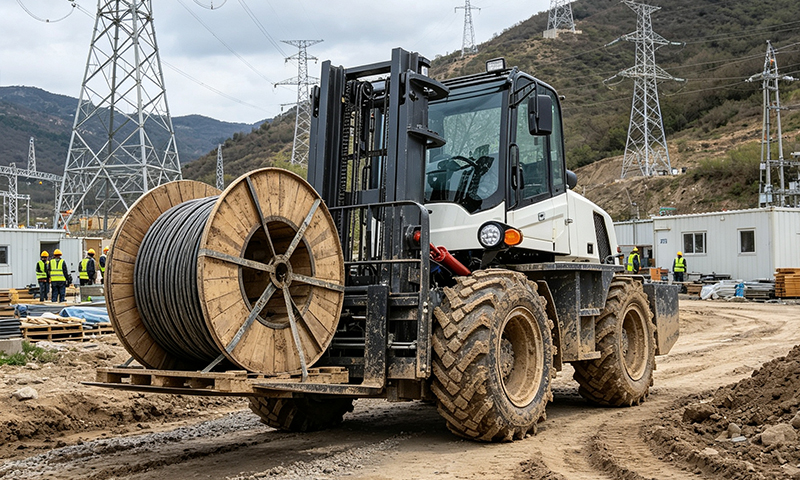
On remote infrastructure and utility projects, a HAMAC FD60-RT 6 ton rough terrain forklift is used t
Free Consultation >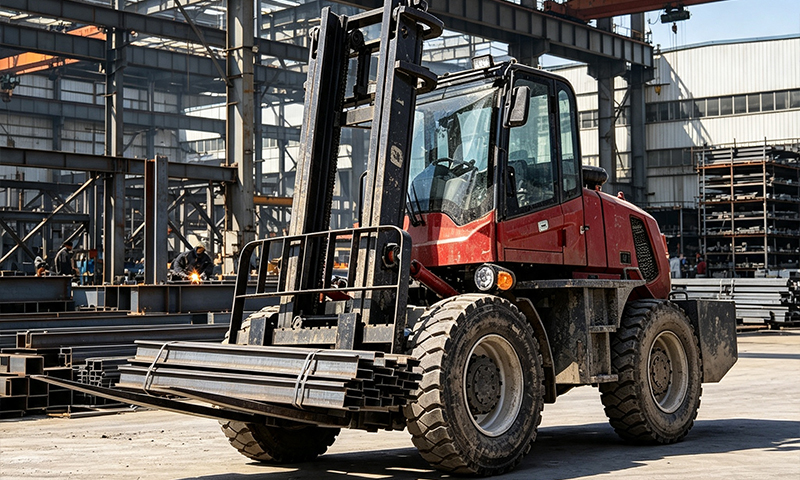
In a steel fabrication plant, a rough terrain forklift is used to move steel beams, plates and heavy
Free Consultation >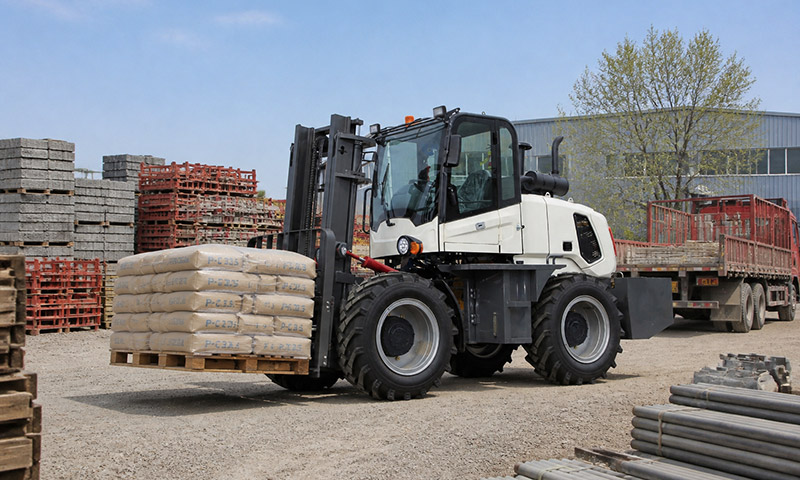
FD60‑RT 6 ton rough terrain forklifts are used in a precast concrete yard to move and stage heavy b
Free Consultation >Please fill out the form, and we can satisfy any of your needs including equipment selection, scheme design, technical support, or after-sales service. We will contact you as soon as possible.