FD50‑RTD
Rough Terrain Forklifts
Rated load capacity: 5,000 kg
Maximum lift height: approx. 4,500–6,000 mm
Consult now






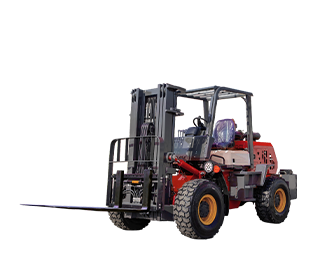
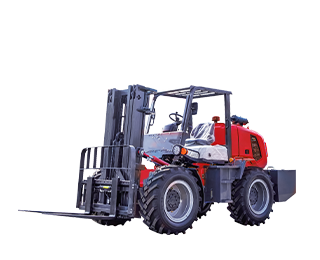
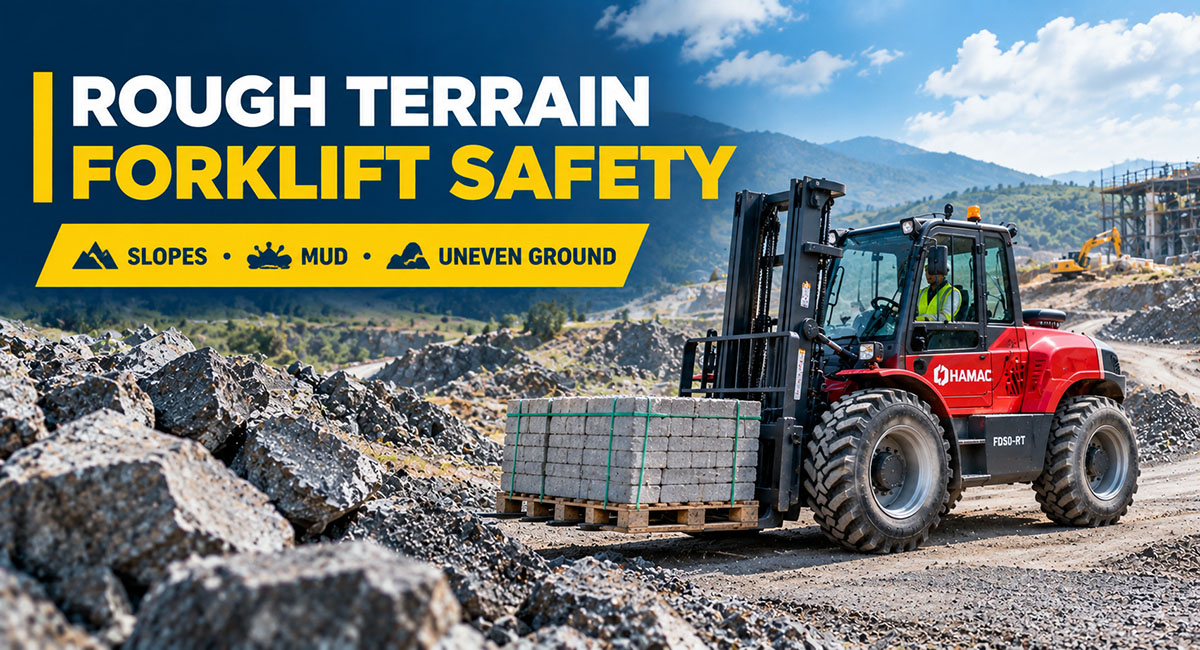
A rough terrain forklift is designed for outdoor material handling on gravel, dirt, mud, farm roads, construction sites and uneven access routes. Its 4WD drive system, deep-tread tires and higher ground clearance can improve traction and mobility. However, these features do not make every slope, muddy route or uneven surface safe.
Safe operation depends on ground stability, actual load weight, travel direction, tire condition, speed, visibility and the manufacturer’s operating limits. Before every shift, inspect the route, keep loads low and stable, and stop work if the ground or load becomes unsafe.
HAMAC offers rough terrain forklifts for construction, farms, timber yards, stone yards and outdoor logistics. This guide provides practical safety reminders for operating on slopes, mud, gravel and uneven ground.
| Check Area | What to Confirm |
|---|---|
| Ground | Firm surface with no soft soil, standing water, deep ruts, loose rock, open trench or unsafe edge. |
| Slope | Grade is within the machine manual and site operating limits for the actual load and surface condition. |
| Load | Actual total weight, load centre, pallet condition, fork support and attachment configuration are confirmed. |
| Route | Travel path is clear, wide enough, visible and separated from pedestrians and other vehicles. |
| Machine | Tires, brakes, steering, forks, attachment locks, hydraulics and warning devices are in safe condition. |
A 4WD rough terrain forklift can improve traction, but it cannot correct an overloaded machine, unstable ground, a side slope, a loose load or unsafe speed. Inspect the route before entering it, especially after rain, excavation work or heavy vehicle traffic.
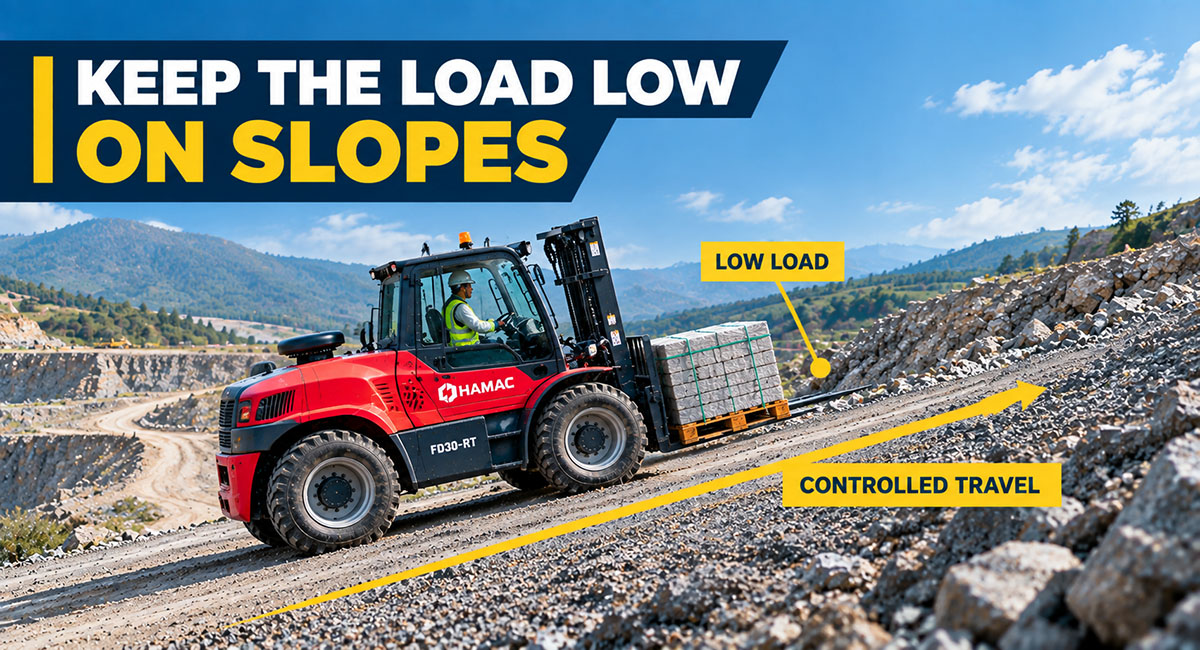
Slopes increase the risk of load shift, loss of traction and tip-over. Travel straight up or straight down a slope whenever possible. Avoid travelling diagonally across a slope and never turn on a slope unless the manufacturer manual and site procedure specifically allow it.
| Safe Practice | Why It Matters |
|---|---|
| Keep the load low during travel | A low load helps keep the centre of gravity lower and improves stability. |
| Keep the load facing uphill | Keeping the load uphill helps reduce the risk of forward load shift and instability. |
| Travel straight up or down the slope | Diagonal travel and side-slope movement can increase side-tip risk. |
| Use slow, controlled speed | Sudden acceleration, braking or steering can reduce traction and destabilize the load. |
| Do not turn on a slope | Turning shifts weight sideways and can move the centre of gravity outside the stability area. |
| Use a spotter when visibility is restricted | A trained spotter can help the operator identify route hazards, people and obstructions. |
With a load, keep the load uphill: travel forward uphill and reverse downhill where this is consistent with the equipment manual and site procedure. Keep forks low, the load close to the carriage and the mast appropriately tilted to support load stability. Do not rely on a general slope percentage from another machine; the permitted grade depends on the forklift model, load, surface, tires and operating conditions.
Mud and soft ground can reduce traction and, more importantly, may not support the combined weight of the forklift and its load. If wheels begin to spin, ruts deepen quickly, the machine sinks or the route changes after rain, slow down and stop to assess the situation.
Four-wheel drive improves traction, but it does not mean soft soil can support the machine safely. If the ground is unstable, relocate the work area or improve the access route rather than taking additional risk.
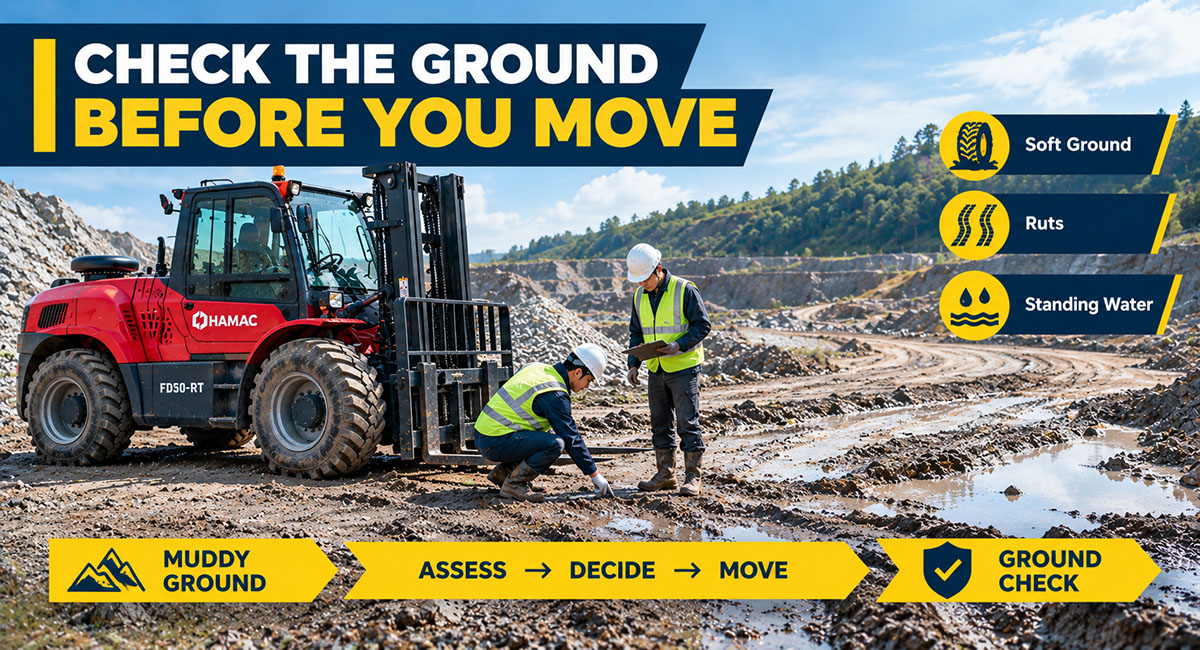
Uneven ground can cause sudden load movement when one wheel drops into a hole, crosses a rock or travels along a rutted path. Side slopes are especially dangerous because they shift the load and machine weight toward one side.
Rough terrain forklifts are designed for outdoor use, but stability still depends on load weight, load centre, tire condition, route preparation and operator control. Keep the forklift on stable ground and avoid using “rough terrain” capability as a reason to ignore site hazards.
On uneven ground, a load that is safe on a flat concrete floor may become unstable. Confirm the real total load before travel: include the material, pallet, steel stillage, forks, attachment and any lifting accessories.
| Load Control Rule | Safe Practice |
|---|---|
| Keep Loads Low | Carry the load as low as practical while maintaining route clearance. |
| Keep Loads Close | Position the load close to the fork carriage and use correct fork spacing. |
| Check Load Stability | Inspect pallet boards, wrapping, straps, stillages and the centre of gravity before travel. |
| Reduce Speed | Slow down for mud, gravel, ruts, slopes, turns and poor visibility. |
| Follow Rated Capacity | Use the data plate and manufacturer guidance; do not overload or use an unsuitable attachment. |
The HAMAC FD30-RT is a 3 ton 4WD rough terrain forklift for construction and farm use. The HAMAC FD50-RT is a 5 ton 4x4 diesel forklift for heavier outdoor loads in stone markets, timber yards and construction sites. Their rated capacities do not replace the need to assess actual load weight, load centre, ground and operating conditions before every task.
| Unsafe Condition | Required Action |
|---|---|
| Tires spin, the machine sinks or ruts deepen quickly | Stop, lower the load and assess ground stability and the exit route. |
| Ground is soft, waterlogged, cracked, steep or close to an open trench | Do not continue; use a safer route or improve the work surface. |
| Load shifts, leans, breaks, blocks visibility or is not fully supported | Stop and restack, secure or reposition the load before travel. |
| Brakes, steering, 4WD, hydraulics, tires, forks or attachment locks are faulty | Tag out the forklift and report it for inspection or repair. |
| People enter the travel route or lifting zone | Stop and clear the area before moving again. |
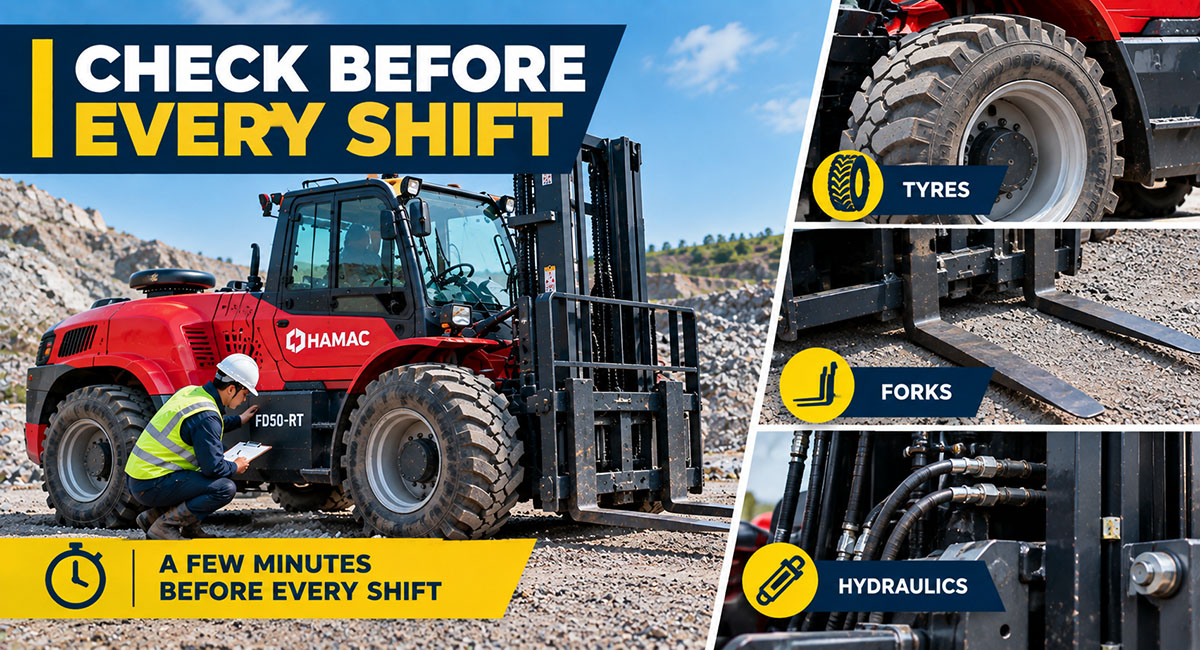
| Check Item | OK | Needs Attention | Stop and Report |
|---|---|---|---|
| Tire tread, pressure, sidewalls and wheels | □ | □ | □ |
| Brakes, steering, 4WD function and warning devices | □ | □ | □ |
| Forks, fork locks, attachment and hydraulic hoses | □ | □ | □ |
| Actual load weight, load centre and pallet condition | □ | □ | □ |
| Slope, mud, ruts, standing water, trench edges and travel route | □ | □ | □ |
| Visibility, spotter requirement and pedestrian exclusion zone | □ | □ | □ |
A rough terrain forklift is built to improve mobility in outdoor conditions, not to remove the risks of slopes, mud, side slopes or unstable ground. Keep loads low, travel slowly, keep the load uphill on slopes, avoid side-slope travel and stop when the route or load becomes unsafe.
Contact HAMAC for rough terrain forklift selection, technical information and quotation.
Can a rough terrain forklift operate safely on a slope?
It can operate only within the manufacturer’s slope limits and site safety rules. Travel straight up or down where possible, keep the load low and uphill, avoid turning on slopes and reduce speed.
What should I do if a rough terrain forklift gets stuck in mud?
Stop before wheel spin deepens ruts or causes sinking. Lower the load, assess the ground and exit route, then use a firmer prepared route or improve the ground before continuing.
Does 4WD make it safe to work on any ground?
No. Four-wheel drive improves traction but cannot make soft, waterlogged, unstable or excessively sloped ground safe. Ground bearing capacity and stability must still be assessed.
Why should a forklift load face uphill?
Keeping the load uphill helps reduce forward load shift and improves stability. With a load, operators commonly travel forward uphill and reverse downhill, subject to the machine manual and site procedure.
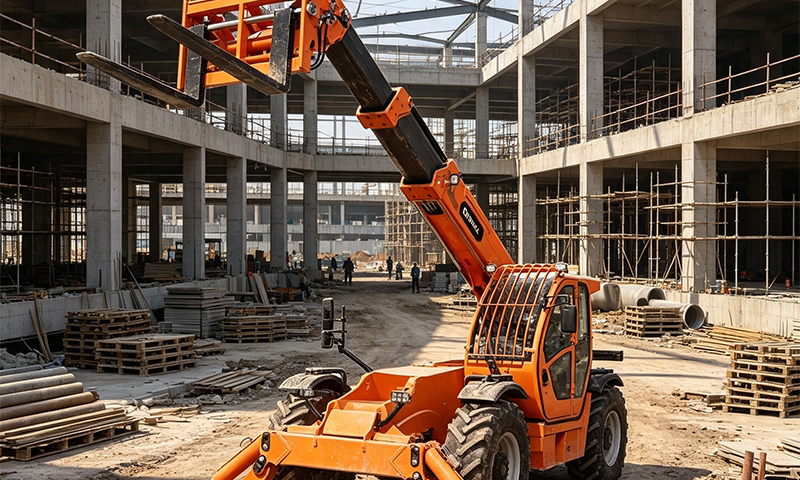
This case study describes how an HT5014 telehandler supports outdoor storage rack replenishment besid
Free Consultation >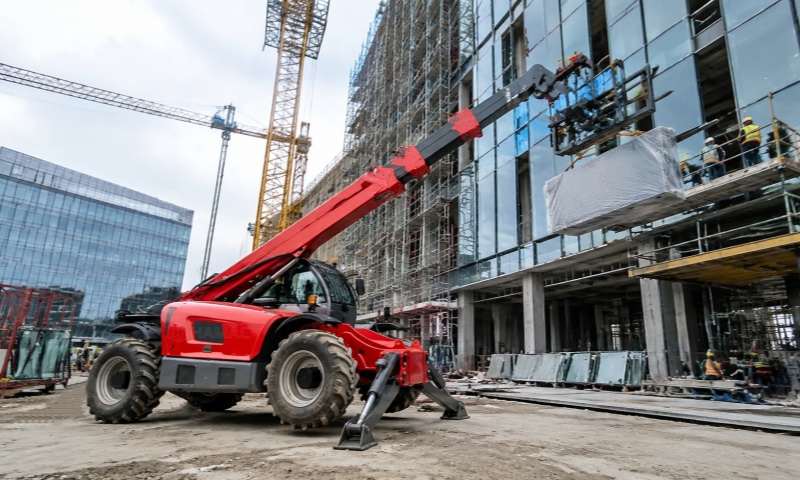
On a commercial building project, an HT4010 telehandler is used to assist facade and curtain wall ins
Free Consultation >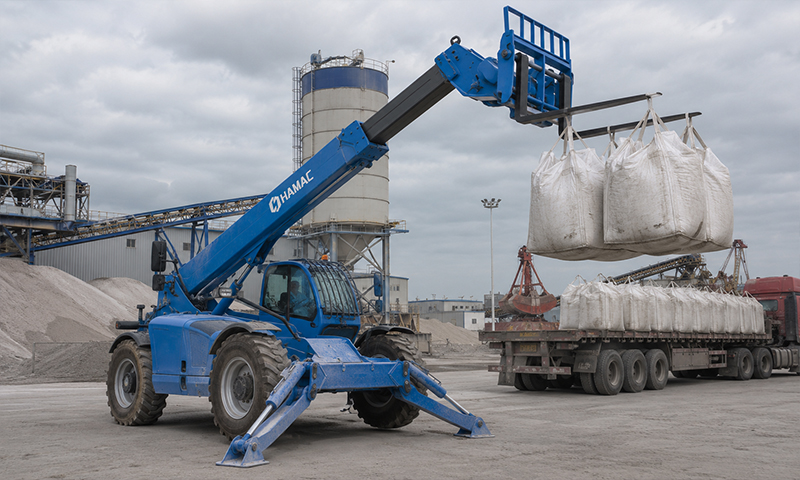
At inland port terminals, a high‑capacity telehandler is used to transfer bulk materials between tr
Free Consultation >Please fill out the form, and we can satisfy any of your needs including equipment selection, scheme design, technical support, or after-sales service. We will contact you as soon as possible.